


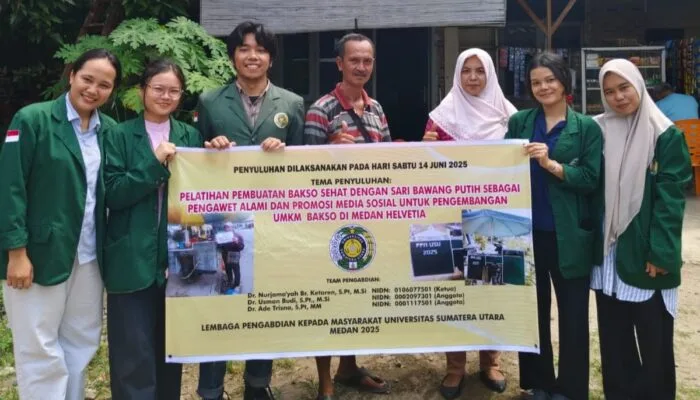
A team of lecturers from the University of North Sumatra (USU) provided training on making healthy meatballs for MSMEs in Helvetia Tengah Village, Medan Helvetia District. This activity was part of the Community Service (PKM) program, which carried the theme "Economics and Social Affairs" in an effort to support small business development and improve the quality of local food.
The training, held on Jalan Perkutut, Gang Masjid Ujung, was led by three USU lecturers: Dr. Nurjama'yah Br. Ketaren, S.Pt, M.Si, Dr. Usman Budi, S.Pt., M.Si, and Dr. Ade Trisna, S.Pt, MM. They were accompanied by students from the USU Animal Husbandry Study Program, including Ngonda Sari Harahap, Ista Maria Tamba, Grace Brigita Ruth Novianti Nababan, Novelin Panjaitan, and Bronson M. Simanjuntak.
During the training, the MSMEs were educated on the use of garlic juice as a natural preservative for meatballs. This addresses the main problem faced by vendors: meatballs that spoil quickly when stored at room temperature. Typically, meatballs made in the morning are slimy and smelly by the afternoon.
"Garlic contains the compound allicin, which has antimicrobial, antiviral, and antioxidant effects. It is very suitable as a natural preservative alternative to dangerous chemicals like formaldehyde," explained Dr. Nurjama'yah.
In addition to functioning as a natural preservative, garlic can also naturally enhance the flavor of meatballs without the need for artificial flavorings like MSG, sasa, or roiko, which are known to be harmful to health.
Beyond focusing on production, the community service team also equips MSMEs with modern marketing strategies through social media platforms like Instagram and Facebook. Until now, sales of MSME meatballs in the Helvetia area have been limited to school environments, with children as the primary consumers.
"With improved quality and digital marketing strategies, consumer reach can be expanded to a wider community," said Dr. Usman Budi.
The community service team also promoted more attractive meatball packaging through the use of stickers on the cups, as well as variations in broth and presentation to attract buyers.
In this training, participants were introduced to the use of various local spices such as ginger, galangal, spring onions, and fried shallots and garlic. These ingredients not only enhance the flavor but also naturally extend the shelf life of the meatballs.
In addition to direct training, the team also distributed leaflets and a guidebook for making healthy meatballs. This book covers marinating techniques with garlic juice and the use of other natural food additives such as salt and sugar.
This activity is expected to have a tangible impact on meatball MSMEs, both in terms of product quality and market expansion. By improving the durability and deliciousness of the meatballs, along with promotion through social media, their businesses are expected to grow further, increasing income and family well-being.
"We not only provide training, but also ongoing mentoring and evaluation so that these businesses can truly thrive," concluded Dr. Ade Trisna.