


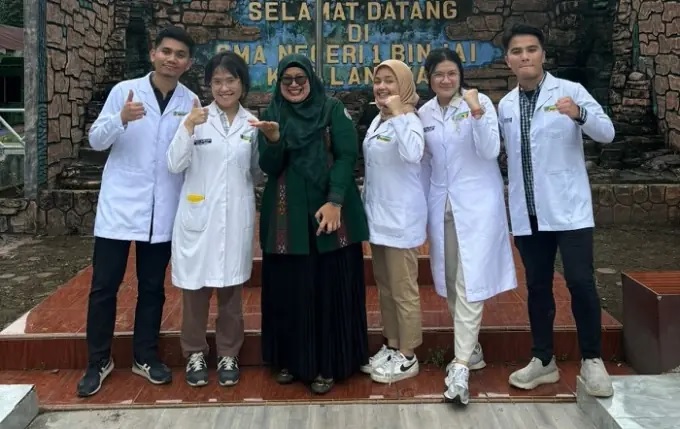
MEDAN, SUMUTPOS.CO – The Community Service Team of the Faculty of Medicine, University of North Sumateta (FK USU) educates and socializes the eradication of mosquito nests (PSN) with the 3M Plus movement to students and teachers, at SMA Negeri 1, Binjai District, Langkat Regency, Thursday (20 /6).
3M Plus, namely draining water reservoirs, burying used goods, and closing water reservoirs, to prevent nests and inhibit the development of mosquitoes.
Present at this activity were the Chair of the USU FK Community Service Team, Prof Dr Dr Rina Amelia MARS Sp KKLP SUBS FOMC and members, Dr Hendri Wijaya MKed(Ped), SpA(K), Dr Yuki Yunanda MKes and Dr Putri Chairani Eyanoer MS Epi PhD Sp KKLP and students, namely Indira Salsabilla, Hafizh Hardi Habiibi, Kezia Claudya Roito Silaen, Nadya Joana Marpaung and Samuel.
Prof. Dr. Rina said that the implementation of health care efforts in Indonesia has not currently been implemented in a comprehensive, integrated and sustainable manner. The high incidence of disease outbreaks, one of which is the dengue hemorrhagic fever (DHF) outbreak, is an example of a case that shows that promotive and preventive health maintenance programs are still not in line with and have not been implemented well with the Healthy Indonesia Program which focuses on disease prevention, because All regions in Indonesia are at risk of contracting dengue fever.
"Until now, there is still a tendency for the number of dengue fever patients to increase and its spread, so that dengue hemorrhagic fever (DHF) is one of the most common public health problems in Indonesia, both as an endemic and epidemic disease," he said.
DHF, continued Prof. Rina, is found almost all over the world, especially in tropical and subtropical countries. Increased dengue vector activity is usually associated with high rainfall which causes large pools of water, especially in places that can become water reservoirs when it rains, making it easy for dengue disease to be transmitted to humans through vectors, namely the bites of the Aedes Aegypti and Aedes Albopictus mosquitoes. .
"Several studies show that children and adolescents are more susceptible to dengue fever than other age groups, although this disease can attack anyone regardless of gender or age group," he said.
To stop the chain of transmission of dengue fever, continued Prof Rina, various efforts can be made, such as improving the quality (sanitation) of the environment, reducing the population of the Aedes Aegypti mosquito as a vector for dengue fever, disease prevention and immediate treatment for dengue sufferers.
"However, what is important to pay attention to is increasing understanding, awareness, attitudes and changes in people's behavior towards dengue fever, because this will really support efforts to break the chain of dengue transmission," he added.
He explained that the activity of re-cultivating the behavior of eradicating mosquito nests (PSN) with the 3M Plus Movement on a regular basis, is an effort to reduce the number of extraordinary cases of dengue fever in preventing and controlling the disease.
Prof. Rina explained that the behavior of cleaning the environment and carrying out regular 3M activities, such as draining water reservoirs, burying used goods, and closing water reservoirs, is effective in reducing mosquito breeding sites, thereby reducing the number of dengue fever incidents in the environment.
"3M Plus's expanded activities include changing the water in flower vases, bird drinkers or other similar places once a week, repairing water channels and gutters that are not running smoothly, closing holes in bamboo or tree cuttings, sprinkling larvicide powder, raising larvae-eating fish. ", installing wire mesh, ensuring adequate lighting and ventilation of the room," he explained.
According to Prof. Rina, considering children's vulnerable immune systems and lack of knowledge about infectious diseases, especially environmental ones, dengue fever attacks children very easily. Therefore, the School functions as a second home in teaching children a good way of life, including health.
“School children are very sensitive to change because they are in a phase of growth and development. At this stage, the child's condition is very sensitive to stimuli, so it is easy to educate, direct and instill good habits, including healthy living habits. In addition, at this age, children have realistic and critical observations. "This shows that they have reached the stage of maturity and have the ability to think logically and critically," he explained.
He said that school children also have great curiosity and a desire to learn. Therefore, it is very important for school age children to know about how to prevent dengue fever by carrying out PSN so that their awareness is instilled.