


Medan, - The current massive digitalization era allows for discriminatory behavior, for example, providing certain facilities to one of the digital economy platforms. Other forms can be exploitation of different businesses, such as platforms against suppliers or exploitation between platforms.
This discrimination cannot be avoided. Furthermore, Predatory pricing (loss-selling practices) is a business strategy that is considered appropriate to win the market. E-commerce and start-ups compete to sell goods at low prices by providing discounts and the best quality and service, the impact on market concentration on competition which will result in an unhealthy business climate.
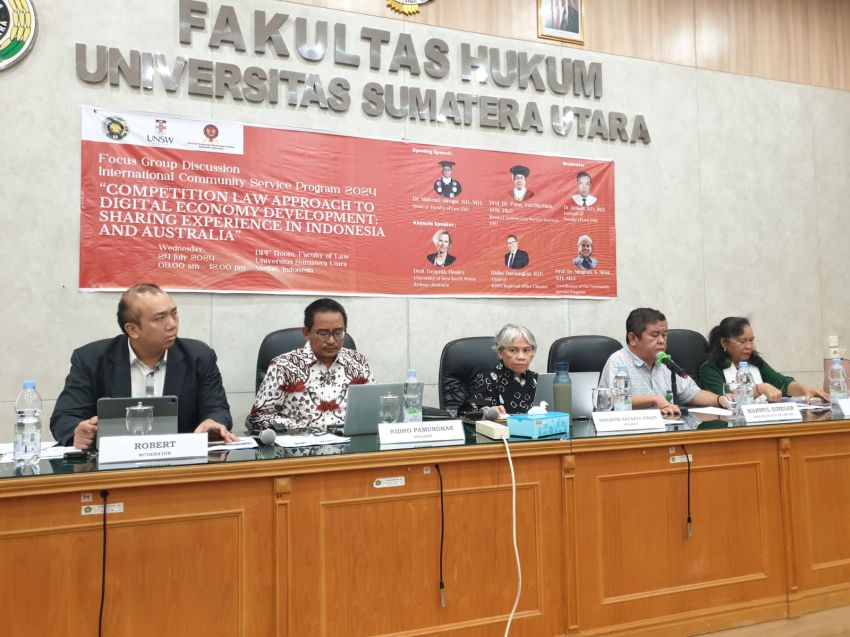
Responding to the issue of unhealthy business competition that may occur on the digital economy platform, the Community Service Team of the Faculty of Law ofUniversitas Sumatera Utara, in collaboration with the University of New South Wales, Sidney-Australia and the Business Competition Supervisory Commission (KPPU) Regional Office I, held a Community Service activity with an International collaboration scheme in the form of a focused discussion entitled "Competition Law Approach to Digital Economy Development: Sharing Experience in Indonesia and Australia".
The activity, which was carried out in a hybrid manner in the DPF FH USU Room, presented speakers including community service partners, namely Professor Deborah Healey from the School of Private & Commercial Law UNSW, Sidney-Australia who attended online, Ridho Pamungkas as Head of Regional Office I of the Business Competition Supervisory Commission (KPPU), and Professor Ningrum Natasya Sirait, Professor of the Faculty of Law USU, and was guided by Dr. Robert, SH.M.H. Participants of the activity who attended online and offline included lecturers and students of the undergraduate and postgraduate students of Universitas Sumatera Utara Faculty of Law, the North Sumatra Cooperative and UMKM Service, the North Sumatra Chamber of Commerce and Industry, the North Sumatra Indonesian Employers Association, the North Sumatra UMKM Association, the DPP IKM UMK Nusantara, and business actors in the digital economy sector in Medan City.
The Dean of the USU Faculty of Law, Dr. Mahmul Siregar, SH.M.Hum, in his remarks revealed the limited understanding of business actors regarding the development of the digital economy in Indonesia in the context of business competition law.
"This activity is expected to provide new insights in overcoming obstacles and challenges in supervising digital economic business competition in Indonesia in order to create a healthy business climate," said Mahmul
Continued with a discussion about a comparison of digital economic business competition problems that occur in Indonesia and Australia. The discussion began with a presentation from Prof. Ningrum Natasya Sirait as the discussion starter, stating that in anticipating the negative impacts of the presence of the digital economy for MSME business actors, the government should play a role and be active in accommodating the interests of all parties, be it business actors, associations, the community, and others. The government should also be able to take concrete steps to resolve these various problems.
"The government must be careful, when an e-commerce platform is ordered to close, then those who receive the negative impact of the closure of the e-commerce are the MSMEs in the e-commerce itself," said Ningrum.
Professor Ningrum Natasya Sirait's statement was confirmed by Professor Deborah Healey who revealed that Australia also faces the same problems and challenges as Indonesia in responding to the relationship between giants in the digital world and other business actors.
"The Australian government funds the ACCC (Australian Competition Authority) to research specific issues related to digital platforms. The results of this research will later be in the form of recommendations or policy suggestions in amending the competition law in Australia," said Deborah.
Furthermore, Ridho Pamungkas stated that the problem of business competition in the digital economy is one of which is marked by competition between business actors who have already entered the market with innovators who have just entered the market. Regarding the attitude of MSMEs in the digital economy era, Ridho encouraged MSMEs to be digitally literate.
"MSMEs must be able to use digital technology to develop their business. The presence of this digitalization is not to be fought, but to be utilized," said Ridho.
In the question and answer session, the participants were very enthusiastic about asking questions to the speakers.
In the Conclusion session which was the end of the activity, Prof. Ningrum Natasya Sirait again conveyed that behavioral changes are not an admission of guilt by business actors who are suspected of carrying out anti-competitive behavior. This situation should be addressed wisely by the Indonesian government in the form of legal certainty through the availability of legal regulations for supervising business competition like Australia has. Learning from each other is a common thing for the good and we will continue to share experiences and knowledge to be able to consumer welfare in accordance with the objectives of Competition Law.
Source: https://www.medanposonline.com/ekonomi/4547/fakultas-hukum-usu-kppu-dan-unsw-sidney-australia-gelar-fgd-dekatatan-hukum-persaingan-di-sektor-ekonomi-digital/