


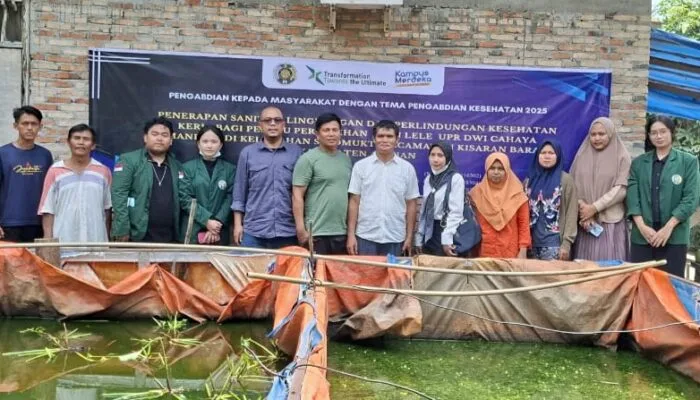
The theme of this activity was "Implementation of Environmental Sanitation and Occupational Health Protection for Catfish Hatcheries" as an effort to increase the productivity of environmentally friendly catfish farming while protecting the health of workers.
The program was chaired by Prof. Dr. Dra. Irnawati Marsaulina, MS, with team members Dr. dr. Tasrif Hamdi, M. Ked(An), Sp. An-TI, Subsp. MN(K), Dhani Syahputra Bukit, SKM, and three students from the Faculty of Public Health, University of Indonesia (USU): Carlos Sinaga, Melati Manurung, and Nathania Raihanah. Prof. Irnawati explained that aquaculture, particularly catfish hatchery farming, has very promising prospects for driving economic growth in the community. However, the success of this business depends not only on the technical aspects of hatchery production, but also on the implementation of good environmental sanitation and health protection for the workers involved.
"The quality of the seed, both in terms of quantity and quality, will determine the success of fish farming. Therefore, the implementation of environmental sanitation and occupational health protection are factors that cannot be ignored," he said. This community service activity has the primary goal of empowering the Sidomukti Village community to manage catfish hatcheries in a healthy, safe, and sustainable manner.
In addition to improving technical skills, this activity also focuses on raising public awareness of the importance of occupational health through the use of personal protective equipment (PPE).
The program is implemented through four main stages. The first stage is an initial survey, which includes mapping the physical conditions of the location, the number of catfish farmers, and identifying sanitation and worker health protection issues.
The second stage is the socialization of the activity plan, where the team provides an explanation of the program to be implemented and hands-on facilities designed to strengthen catfish farming with modern methods. The third stage is the implementation of empowerment, which includes training on the application of environmental sanitation in catfish farming and training on occupational health protection through the use of PPE. During this stage, participants are provided with practical knowledge and live demonstrations on how to manage waste, maintain a clean work environment, and prevent occupational diseases.
The fourth stage is the evaluation and handover of equipment to partners, including liquid waste treatment facilities, safety equipment, and supporting equipment for catfish hatchery production. Further efforts undertaken in this community service program include improving skills and business management. To support this business management, ideal cultivation ponds have been arranged, superior broodstock have been provided, and work equipment has been provided for the groups.
Six Months
This community service program is planned to last six months. Targets include increasing community knowledge and skills in environmentally friendly catfish production strategies, providing liquid waste treatment facilities from catfish production, and increasing awareness of the importance of occupational safety and health. With this program, it is hoped that the Sidomukti Village community will not only be able to produce high-quality catfish fry but will also be able to maintain worker health and environmental sustainability. "We hope this activity will have a sustainable impact, both economically and in terms of public health," added Prof. Irnawati.
Partners warmly welcomed the USU Community Service program, as it directly addresses the fundamental needs of fish hatchery activities and daily life. Partners directly follow up on input and suggestions provided by the Team.