


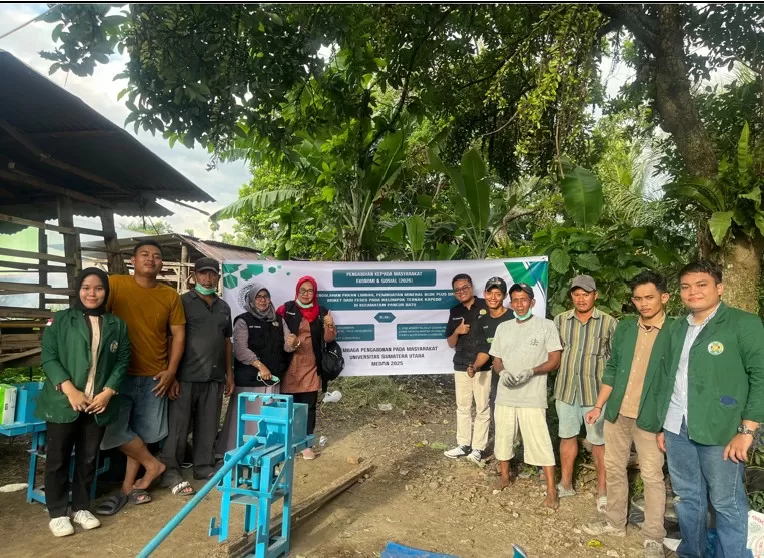
Innovation in the field of smallholder livestock farming continues to show encouraging progress. One example is seen in Hamlet 3, Sei Glugur Village, Pancurbatu District, Deliserdang Regency.
The KaPeDo livestock farming group in this village has successfully transformed their conventional livestock farming system into a superior livestock system based on environmentally friendly waste management.
This transformation was made possible thanks to the Community Service (PKM) program conducted by the Institute for Research and Community Service, Faculty of Agriculture, University of North Sumatra (LPPM FP USU). This PKM activity was coordinated by Prof. Dr. Ir. Yunilas, MP, along with team members Dr. Dra. Elimasni, MSi, Mhd. Adanan Purba, SPt, MSc, PhD, and Muhamad Amran, SPt, MPt. This program aims to improve the knowledge, skills, and independence of livestock farmers in managing their businesses more efficiently and sustainably by utilizing agricultural and livestock waste as an alternative resource with economic value. Prior to the activity, the PKM team conducted field observations to identify various problems faced by livestock farmers, such as limited land for forage, high commercial feed prices, and the suboptimal utilization of fecal waste, which has the potential to pollute the environment.
Based on these findings, the team designed an integrated approach by introducing appropriate technologies, including waste-based feed fermentation technology, the manufacture of mineral block plus supplements, the production of biobriquettes from livestock feces, and the use of local microorganism solutions (MOL) and eco-enzymes as bioactivators in the fermentation process.
Through a series of training sessions and hands-on practice, the farmers were provided with the understanding and skills to make complete silage. Complete silage is a highly nutritious fermented feed that is long-lasting and effective as an alternative feed during the dry season or when forage availability is limited.
This feed is processed from agricultural waste such as corn stalks, straw, and harvest leaves, which were previously discarded or burned. With the addition of MOL as a fermentation promoter, the resulting silage is prepared more quickly and is of high quality.
In addition to feed, farmers are also taught how to make mineral block plus supplements. This product differs from regular mineral blocks because it is enriched with herbal ingredients containing antioxidants. This supplement not only helps meet livestock's mineral needs but also improves immunity, aids growth, and reduces stress, especially during transport.
Based on research by the community service team, this supplement has been proven to significantly reduce stress levels in sheep during transport. Another innovative aspect is training in the production of biobriquettes from livestock feces. Previously a source of pollution, fecal waste is now processed into an environmentally friendly alternative fuel. The manufacturing process involves mixing feces with charcoal as an additional raw material and tapioca flour as a binder.
According to Muhamad Amran, SPt, MPt, the success rate of biobriquette production depends heavily on the consistency of the adhesive solution. If it is too runny or too thick, the binding process will not be optimal.
This transformation was welcomed by the KaPeDo livestock group, chaired by M. Rifa'i. Previously, livestock farming was considered a side business or savings. However, after mentoring from the USU Community Service Program (PKM) team, this group began to see the opportunity to turn livestock into a sustainable commercial enterprise. In fact, some farmers have begun producing silage, MOL, and biobriquettes independently. Surya, SPt, a member of KaPeDo, said that this program was the first time their village had received community service directly from a university.
"I am very enthusiastic and hope this kind of training can be conducted continuously to strengthen the capacity of local farmers," Surya said.
This activity also involved students from the USU Faculty of Agriculture, including Fani Natasya Pratiwi, Jose Jonery Silangit, Sibtia Alfis Syahri, Taufikul Hafizh Bin Rahmad, Rheymita Zalfa Afiyah, and Anjeli Wardah Sitanggang. The presence of students not only facilitated the training but also provided a real-world space for them to apply their knowledge in the community. The activity coordinator, Prof. Dr. Ir. Yunilas, MP, explained that the main goal of this program was not only to increase livestock farmers' incomes but also to raise awareness of the importance of environmental management and resource efficiency through a zero-waste approach. "I also hope that this kind of activity can be expanded to other villages in North Sumatra, so that its impact can be felt more widely," said Prof. Dr. Ir. Yunilas, MP.
The PKM Team of the USU Faculty of Agriculture's LPPM and the group KaPeDo expressed his gratitude to the Chancellor of the University of North Sumatra, Prof. Dr. Muryanto Amin, SSos, MSi, and the Head of LPPM USU, Prof. Dr. Tulus, Vor.Dipl.Math., MSi, PhD, for their full support and assistance with equipment that greatly helped the smooth running of the program.