


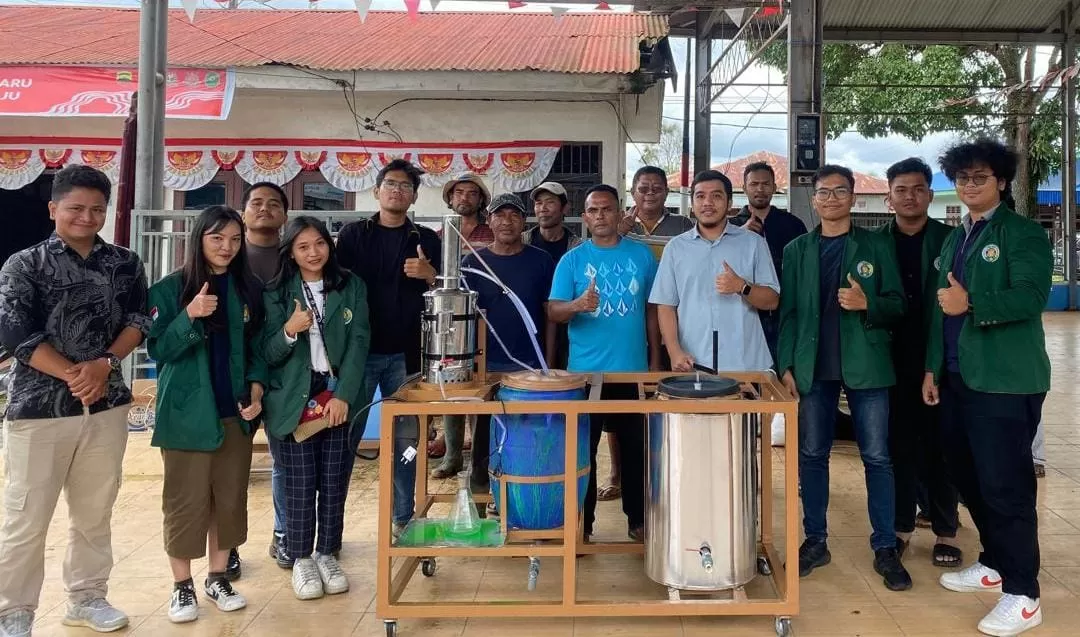
SEMPAJAYA VILLAGE, - Lecturers and students of the Faculty of Engineering, Universitas Sumatera Utara (USU) carried out community service with an economic and social scheme of the Community Service and Service Institute of Universitas Sumatera Utara (LPPM-USU) which was decided to be implemented in Sempajaya Village, Berastagi District, Karo Regency, Sunday (15/9).
This service was chaired by Dr. Ir. Bambang Trisaksi, M.Si., with members Muhammad Hendra Sahputra Ginting S.T., M.T., Farida Hanum, S.T., M.T, and Dr. Ir. Taslim, M.Si, IPM assisted by two undergraduate students of the USU Faculty of Engineering, namely Rafael Aginta Sitepu and Vandria Alamsyah.
In the community service entitled "Making Alternative Fuel (e-Bio) from Agricultural Vegetable Waste Using a Distiller in Sempajaya Village, Berastagi District, Karo Regency", the lecturers and students provided counseling on the utilization of unsaleable agricultural vegetable waste.
"So far, this waste has only been dumped into the final disposal site (TPA). This causes environmental problems in the form of the potential for greenhouse gases such as methane to be released into the air," said the Head of the Community Service Team, Dr. Ir. Bambang Trisaksi, M.Sc.
In addition, Bambang continued, the pungent odor is also a very serious problem as a result of the disposal of this waste. Therefore, Bambang hopes that through this community service, a solution can be provided for a method of processing agricultural vegetable waste in the form of potatoes, tomatoes, carrots, mustard greens, cabbage and other vegetables into products with sales value (e-Bio) with simple and easy-to-operate equipment. The remaining solids from the fermenter can be processed into organic fertilizer.
"Agricultural vegetable waste is usually seen as just waste. However, if processed, it can be used as a producer of bioethanol or e-bio that can be used by local residents. So, this activity is not only to reduce waste, but also to provide education to local residents about the use of waste as a producer of environmentally friendly energy," said Dr. Ir. Bambang Trisaksi, M.Si.
The community service activity that was just held is expected to provide new insights in efforts to develop alternative energy. The event began with a comprehensive presentation of material, providing insight into the potential of waste that can be utilized for the needs of residents. After the presentation of the material, the event continued with a demonstration of the use of biogas which invited the enthusiasm of the local community.
Local residents were very enthusiastic about following the demonstration demonstrated by the engineering faculty students. The service members also invited local residents to participate in using the distiller.
"In addition to providing counseling on the use of vegetable waste from agriculture that can be used as bioethanol or e-bio, we also provide counseling on making compost which is expected to help the economy of local residents," explained Bambang again.
Meanwhile, the Head of Sempajaya Village hopes that the activities carried out by lecturers and students of the USU Faculty of Engineering can provide new insights for local residents. "Considering that this kind of technology is still very rarely used in our environment. Therefore, we really hope that through this service, the economy of residents can improve and knowledge about waste utilization will increase," he said.
He considered that this program was right on target because of the abundance of raw materials in the area. "Through the counseling provided by the USU team, it is hoped that residents can process agricultural vegetable waste into useful products, while increasing the knowledge and economy of the local community, and reducing waste that has not been utilized so far," he concluded.
Source: https://sumutpos.jawapos.com/pendidikan/2375107568/dosen-dan-mahasiswa-fakultas-teknik-usu-buat-bahan-bakar-alternatif-e-bio-dari-sampah-sayuran-hasil-pertanian-menggunakan-alat-distilator