


Medan City faces a serious problem related to drug abuse. This phenomenon not only causes medical impacts in the form of physical and mental health problems, but also undermines social order, weakens the productivity of the younger generation, and places a heavy burden on families.
Data from the National Narcotics Agency (BNN) indicates that North Sumatra is among the provinces with a relatively high rate of drug abuse.
This situation demonstrates the need for collaborative and sustainable measures in the rehabilitation and social reintegration of former drug users.
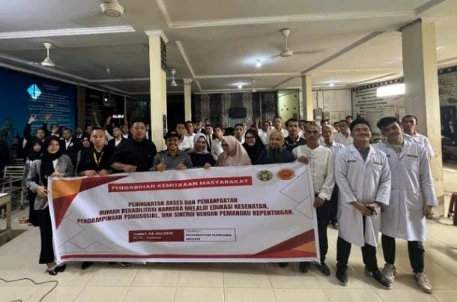
To address this challenge, the University of North Sumatra (USU), through the Faculty of Public Health, implemented a community service program on July 4, 2025, with the theme "Improving Access to and Utilization of Drug Rehabilitation Centers."
This activity focused on providing health education, psychosocial support, and strengthening synergies with stakeholders working in the field of addiction recovery.
The community service team was chaired by Dr. Drs. Zulfendri, M.Kes., with members including Dr. dr. Vita Camellia, M.Ked(KJ), Sp.KJ, and Rahmi Amelia Lubis. S.K.M., M.K.M., as part of the implementation team.
The program also featured two keynote speakers: Eka Prahadian Abdurahman, S.I.Kom., M.K.M., who presented on recovery strategies and relapse prevention, and M. Taufik, Secretary General of the Drug Abuse Research and Development Institute (LRPPN), who is also a hypnotherapy practitioner.

M. Taufik's involvement added a new dimension to this activity, as hypnotherapy is considered a potential supportive therapy for rehabilitation center residents.
The first session featured Dr. dr. Vita Camellia, M.Ked(KJ), Sp.KJ, who presented on the impact of drugs on the brain and mental health.
This comprehensive explanation broadened participants' understanding of how drugs can damage brain function, affect emotions, and even lead to various mental disorders.
Participants enthusiastically asked questions, particularly regarding the management of early symptoms of mental disorders that frequently appear in residents.
The next session was led by Eka Prahadian Abdurahman, S.I.Kom., M.K.M., who presented on relapse prevention. This presentation emphasized the importance of relapse prevention strategies, including self-control techniques, creating a supportive environment, and how to deal with triggers that could potentially lead residents to relapse.
Many participants found the practical examples of coping strategies in risky social situations helpful.
The final session featured M. Taufik, who demonstrated the practice of hypnotherapy as a supportive psychosocial approach to rehabilitation.
"Rehabilitation home residents, their families, and community representatives in attendance gained firsthand experience in how this therapy can help manage stress, foster motivation, and reinforce positive suggestions to stay away from drugs," he said.
Several participants admitted that this was their first time realizing that drug recovery isn't just about medication, but also involves complementary psychological and social approaches.
The event was also attended by Co-Ass students from the USU Faculty of Medicine and the Mental Health Residents from the USU Faculty of Medicine, who played a role in the education and mentoring process.
Their presence made a significant contribution and provided a practical learning opportunity regarding the role of healthcare professionals in addiction rehabilitation.
"We were happy to participate directly because this experience opened our eyes to the importance of empathy in treating patients with drug problems," said one of the co-assists in attendance.
According to Dr. Zulfendri, drug rehabilitation is not only a medical effort, but also a social process that requires the support of many parties.
"Through education and mentoring, we hope residents will gain more confidence in their recovery.
Collaboration between academics, practitioners, and the community," he said, adding that this is crucial for a more effective and sustainable rehabilitation process.
The enthusiasm of the participants and the support of stakeholders demonstrate that this activity provides tangible benefits.
In addition to increasing understanding of the dangers of drugs and the importance of holistic recovery, this program also strengthens the role of rehabilitation centers as safe spaces for former users to rebuild their lives.
Going forward, USU is committed to continuing to develop community service programs relevant to field needs, while also strengthening the contribution of academics in addressing social health issues in Medan.