


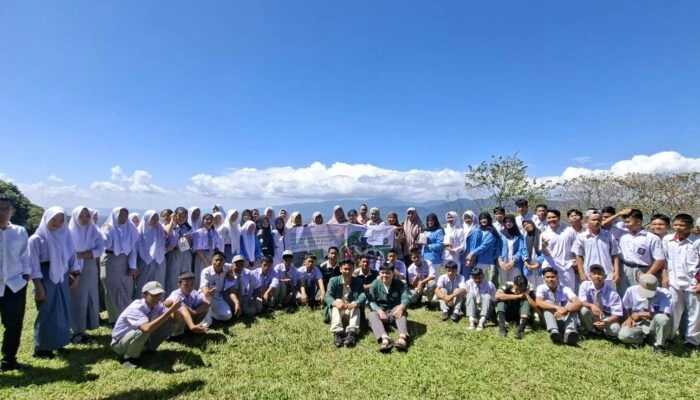
The Faculty of Pharmacy, University of North Sumatra (USU) has implemented a community service program by empowering students and teachers of SMK Martabe Sipirok, majoring in Nursing Assistant and Plantation Crop Agribusiness, in the formulation of liquid hand washing products containing ecoenzymes from Sipirok coffee fruit skin. The community empowerment program was carried out from April to November 2025. With the head of the implementing team, apt. Dwi Lestari P., S.Si., M.Si., PhD (Pharmacy Lecturer) and several team members, Prof. Dr. apt. Julia Reveny, M.Si. (Pharmacy Lecturer), apt. Chemayanti Surbakti, S.Farm., M.Si. (Pharmacy Lecturer), Rahmi Utami, S.T., M.T. (Environmental Engineering Lecturer) and Tengku Mahmud Aria Lamatjiji, ST., MT (Environmental Engineering Lecturer). Dwi Lestari stated that the community service program for teachers and students majoring in Nursing Assistant and Plantation Crop Agribusiness at SMK Martabe was held on July 29, 2025, on Jalan YPMHB, SMA Plus Complex, Padang Bujur Village, Sipirok District, South Tapanuli Regency. This activity received full support from its partner, the Marsipature Hutana Be Education Foundation (YPMHB), which manages SMK Martabe in Sipirok.
"This community service activity is a strategic continuation of the program implemented in 2023 by a team of lecturers from the USU Faculty of Pharmacy in collaboration with students and teachers of SMK Martabe Sipirok," she said. According to her, while the previous program focused on introducing local potential, such as coffee and coffee grounds for making everyday cosmetics and processing kitchen byproducts into ecoenzymes, the 2025 community service program goes further, integrating this knowledge into the formulation of value-added products.
The previous basic training on cosmetic preparation provided participants with an initial understanding. However, the implementation team identified a challenge: participants' limited ability to apply this knowledge to create products ready for production, utilizing existing local resources and having economic value.
Furthermore, environmental issues related to coffee bean husk waste from plantations around Sipirok, as well as coffee grounds from various coffee shops in Sipirok, are increasingly pressing and require solutions.
Therefore, he continued, the 2025 program was designed to address these challenges and as a continuation of the previous program. This project takes a different approach, shifting from simply "learning to make ecoenzymes" to "using the resulting ecoenzymes in product formulation." "This approach allows participants not only to understand the process of processing unused, fresh organic materials or organic byproducts into raw materials, but also to master a crucial stage in the industrial world, namely the formulation of finished products," he said.
This community service program specifically focuses on processing the abundant coffee bean husk waste in Sipirok into ecoenzymes. Exoenzymes, known to possess antibacterial properties, will be the main active ingredient in the formulation of liquid hand sanitizer products, specifically in the form of handwash gel. This innovation not only aims to prevent the accumulation of organic waste but also creates an environmentally friendly cleaning product with high health benefits.
This training, conducted through a series of activities, covers various important aspects, from the initial stages to the final product, in the "Sipirok Coffee Fruit Peel Ecoenzyme Handwash Gel Formulation Training."
Participants are equipped with knowledge and practical skills in processing coffee fruit peels into ecoenzymes that meet quality standards. tertentu,” katanya.

Next, the resulting ecoenzyme is formulated into a handwash gel, and participants learn about proper dosage and manufacturing methods. The final stage of the training involves attractive product packaging and quality evaluation to ensure the product is safe and suitable for distribution. They are also provided with in-depth education on proper handwashing techniques.
Dwi Lestari explained that this program is expected to significantly improve participants' knowledge and practical skills in utilizing local natural resources, particularly coffee, which has previously been known primarily as a beverage. This program is expected to enable participants to create innovative cleaning products from abundant local resources.
"This program is expected to make a real contribution to improving public health and environmental sustainability, in line with Sustainable Development Goals (SDGs) priority 3 on Good Health and Well-being, which aligns with the Indonesian government's Asta Cita 4, one of which targets the health sector," she said.
Furthermore, this activity also targets SDG priority 13 on Climate Action, which calls for rapid action to address climate change and its impacts. The principal of SMK Martabe Sipirok, Mr. Muhammad Khoir Syahbana, expressed his appreciation for this community service activity.
"We at the school are very grateful to USU, especially the Faculty of Pharmacy, for participating in this community service activity. This has enabled students to gain new knowledge about the use of coffee bean skins in cosmetic products. We hope this community service will continue in the future and have a broader impact on society, especially in education, by fostering critical thinking skills," he said.