


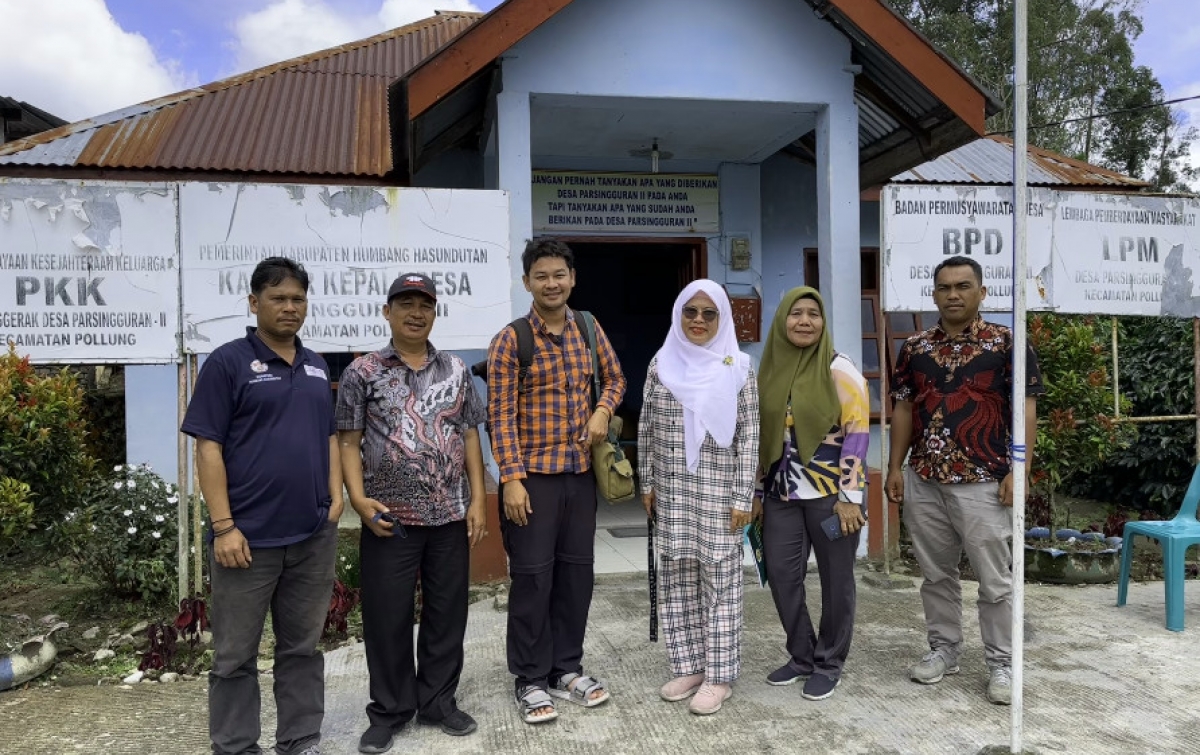
Humbahas - The Community Service Institute of the University of North Sumatra (USU) through the Community Service Team chaired by Samerdanta Sinulingga, S.ST.Par., M.Par., who is a Lecturer in the USU Vocational Faculty's Travel Tour together with USU Students and the Parsingguran II Village Apparatus, Humbang Hasundutan Regency initiated the digitalization of a cloud-based integrated financial system in Parsingguran II Village as a tourism service partner.
Samerdanta explained that the concept of a technology-literate tourist village and/or collaborating completely with technology is a concept that perhaps only a few villages use out of the total villages in the Republic of Indonesia.
He explained that mandatory technology collaboration is only used in the administrative scope of the village government, such as an integrated financial website where all of it has followed the template provided by the central government or citizen data collection connected to inspectorate supervision. Making residents often interpret technology as a scary specter to approach.
"Not to mention that there are still many village leaders in North Sumatra who are gaptek (technologically illiterate), so it is very rare or even still counted the number of village leaders who have been able to collaborate between business and technology in the scope of businesses controlled by the Village. Village-Owned Enterprises are often forced to be creative with limited funds to create large-scale and systemic technical programs but have an integrative and broad impact," he said.
This, he added, certainly increases the stressful and intimidating work environment, because they have to create business potential, but on the other hand it is like being forced to have a 100% success rate. With the background of the majority of residents' activities as farmers, cultivators, maybe fishermen, then suddenly becoming makers of large-scale impromptu businesses such as villages. Business creation instead becomes a drama of elbowing each other internally in the organization. Unlike personal businesses where decisions can be taken and are personally responsible, village business decision-making is absolutely held in village deliberations. As a result, village government programs or village-owned enterprises are very focused on Procurement Programs, such as procurement of facilities, procurement of goods, making parks, etc.
That is the breakthrough that the Lecturer of D3 Travel Tourism Faculty of Vocational, Samerdanta Sinulingga, wants to do.
The creation of an integrated financial system in every business created and run by the village is a central thing to do because it is very related to the character and level of trust internally.
"I want before the business, the way to manage their money and system must be clear. Managing a business in a company is very different from in a village. If I liken the village to a private home, then there are siblings, cousins, uncles, aunts, grandfathers, grandmothers and others. The village is a thick and very sensitive family knit. This family system is then protected by business, called tourism. You have to be fair in doing business with cousins, grandfathers, grandmothers, aunts, uncles, etc. Organizing a business on a village scale is the most fatal and painful business, it's like walking on the edge of a cliff stepping on fragile rocks. Well, the creation of a cloud technology-based business flow system can validate that (anyone can see, or often called an open financial system) everything is carried out as honestly as possible," said the alumni of Udayana University, Bali.
Samerdanta said, this understanding is proof of the urgency of Integrated Financial System Digitalization. The form of this digitalization is that the University of North Sumatra provides the village with 1) a financial application; 2) a mobile tablet computer; 3) and a printer that will later produce a transaction receipt.
The process is as follows: 1) tourists come to the entrance ticketing; 2) the tour operator takes the tablet computer and opens the financial system application; 3) tourists pay the entrance ticket to the operator (handing over money); 4) the operator records the number of people and the amount of money entered into the tablet computer application; 5) based on the tablet computer's command, the printer will issue a transaction receipt; 6) the transaction process then goes to the cloud, 7) anyone can "see" what transactions are currently and have taken place using a personal cellphone; 8) at the end of the month all transactions have been automatically formed into a neat financial report pdf.
Because the nature of the business is not a personal business, but a village business. So it is not uncommon for reports of incoming and outgoing money to be inspected by the Financial Inspectorate, both locally and provincially. This is the second anxiety factor apart from the first factor (business within the scope of kinship) which is prepared by Samerdanta as well as the service team in improving