


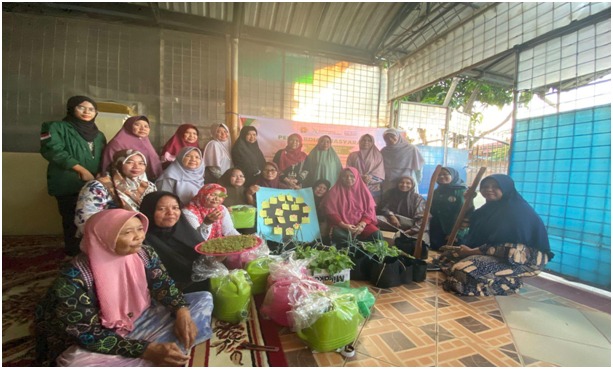
MEDAN, To improve food security for families, the USU LPPM Team went directly to the Aisyiyah Women Farmers Group in Sei Rotan Village, Deliserdang, North Sumatra. This community service activity was carried out with the support of the University of North Sumatra with funding sources from non-PNBP LPPM USU in 2024.
This community service activity focuses on optimizing the potential of household yards as an effort to maintain food security, especially family food security. This community service program will take place from June to September 2024.
With a team consisting of Rahma Hayati S.sos, M.Sos (chairperson). Rahma is a lecturer in the sociology study program. With members Drs, T. Ilham Saladin, M.SP (member), Dra. Lina Sudarwati M.Si (member), which consists of lecturers in the sociology study program. Also included in the team are 3 students from the sociology study program, namely Citra Saputri Dewi, Nahwa Zainab Marpaung, Mhd. Yaderafli Lubis.
The empowerment team has conducted socialization related to the potential owned by the community in Sei Rotan Village. namely the large yard owned by most of the community. The Aisyiyah Women Farmers Group is the driving force in utilizing the yard by farming. However, unfortunately there are several obstacles felt by the Aisyiyah Women Farmers Group so that the utilization of the yard cannot be carried out optimally.
The empowerment team has discussed with all members of the Aisyiyah Women Farmers Group regarding the obstacles they face during the activity of optimizing the yard by farming. Some of the obstacles are the existence of empty land that has not been planted with plants, the lack of availability of agricultural tools, and the lack of group knowledge regarding the cultivation of various plants.
Based on these constraints, the Empowerment Team strengthened the optimization of the yard, starting with meeting the agricultural needs of KWT Aisyiyah such as 3000 seeds and seedlings of horticultural plants, 10 hoes, 10 watering cans, 10 shovels, 2000 polybags, 50 kg of organic fertilizer, and 10 m³ x 200,000 m³ of soil, compost, and burnt rice husks.
The empowerment team provided assistance during the seeding and planting process of horticultural plants. KWT Aisyiyah also has a seedling house that is used to maximize plant growth during the seeding process.
Currently, most of the plant seeds have grown well and are fertile. To motivate KWT Aisyiyah members to be more enthusiastic in efforts to increase food independence, namely by providing rewards and appreciation in the form of superior seeds to 10 selected people who have succeeded in developing their land so that efforts to optimize land and yards are achieved.
In this activity, the service team agreed to design a program using the implementation method of service activities, counseling, training, and assistance. The approach used is Participatory Rural Appraisal (PRA), which is an approach used to formulate planning and policies in rural areas by involving the community (Chambers, 1994).
In this program, the community service team has designed several stages in its success. Namely, the first stage is to provide the needs during the planting process to all members of the Aisyiyah Women's Farmers Group. The provision of needs for farming activities aims to encourage community interest and facilitate the needs they need to be able to utilize their yards optimally.
The second stage, sowing seeds and planting seedlings in the first stage. Namely, the seeds and seedlings that have been given are then distributed to all members of the Aisyiyah Women's Farmers Group evenly. At this stage, all members of the Aisyiyah Women's Farmers Group will plant in their respective yards. Members of the Aisyiyah Women's Farmers Group are also allowed to use all the materials that have been given to facilitate the planting process.
The third stage, sowing seeds and planting seedlings in the second stage. In addition to sowing seeds and planting seedlings in the yard, sowing seeds and planting seedlings are also carried out in the seed house. A seed house is a place or area that is specifically designated as a place for processing plant seeds into seedlings or seedlings so that they can be planted in a wider soil medium.
Sowing of some other seeds is done in the seed house with the aim that seed growth can be more optimal, stable temperature, even air humidity, and protect plant seeds from direct rain and strong winds and seeds can be protected from pest attacks.
Source: https://www.waspada.id/pendidikan/tim-dosen-usu-terjun-ke-kelompok-wanita-tani-aisyiyah-desa-sei-rotan/