


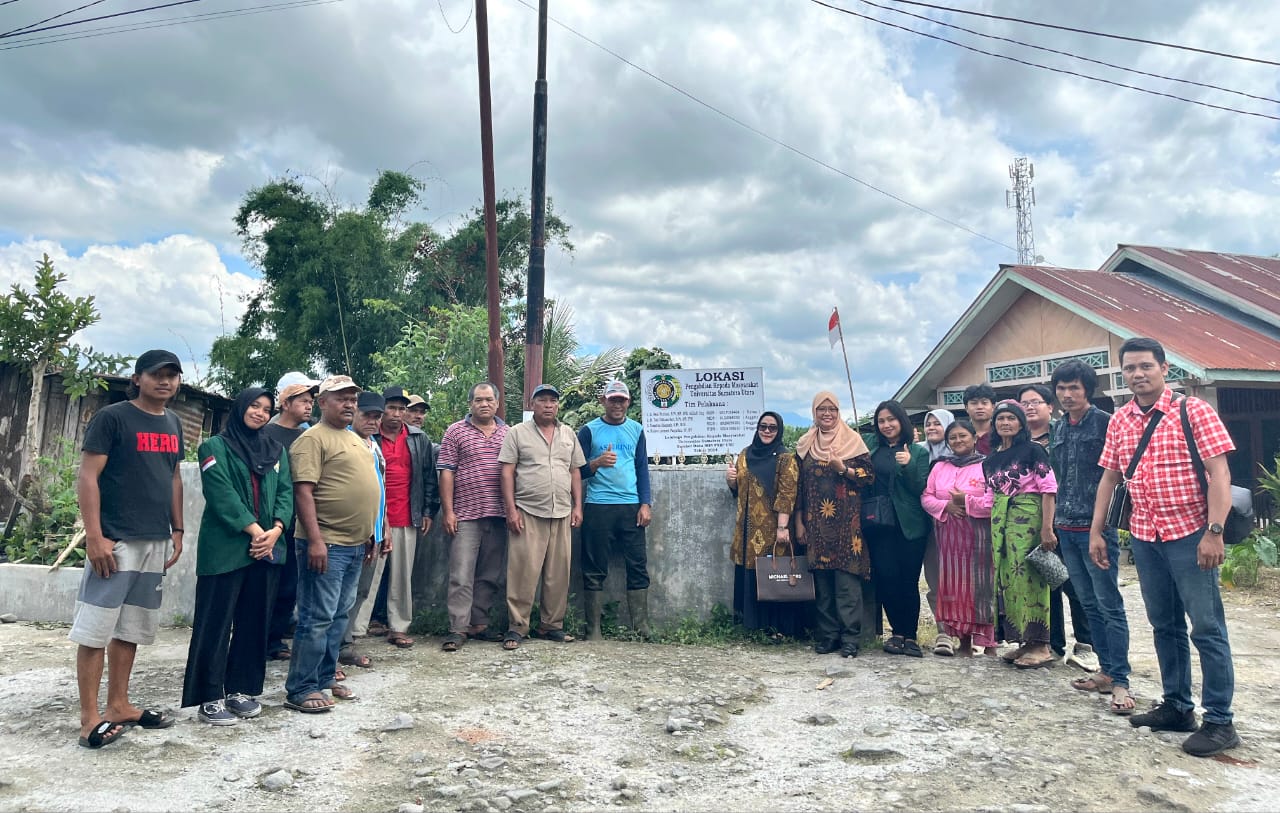
MEDAN, The “Suka Maju” Livestock Group in Suka Village, Tiga Panah District, Karo Regency has long been known as a group with great potential in the fields of agriculture and livestock.
Although the livestock business is quite developed, the traditional management that has been applied so far has limited farmers from achieving maximum profits.
The potential of the agricultural sector in Suka Village actually has opportunities, especially from agricultural waste such as straw.
Unfortunately, this waste is rarely utilized optimally, while in the livestock sector, goats are raised with makeshift feed without paying attention to proper nutritional needs.
As a result, the weight of the goats is not optimal and the livestock are easily infected with disease.
This is not only detrimental to farmers in terms of economy, but also makes their income unstable.
The Community Service Team, namely Lecturers from the Faculty of Agriculture, University of North Sumatra with Chairperson Ir. Peni Patriani, S.Pt, MP, IPM, ASEAN.Eng and several members, namely Ir. Tati Vidiana Sari, S.Pt.,M.P. IPM, Helova Leonard Panjaitan SP, MP and Uswatun Hasanah, S.Pt, M.Si have provided counseling and training in Suka Village, Karo Regency.
Ir. Peni Patriani, S.Pt, MP, IPM, ASEAN.Eng, Friday (16/8) said, this Community Service program is focused on increasing the productivity and welfare of livestock farmers through a series of training and mentoring based on the latest science and technology.
This Community Service Program also involves students of the Faculty of Agriculture, Animal Husbandry Study Program to gain experience outside the campus.
Students involved in this Community Service are 6 people from the Animal Husbandry Study Program, namely Sondang Falentin Br Hutajulu, Sofyan Yacob Sitepu, Lisma Hara Pulungan, Aji Darmawan, Fadinda Tri Regita and Akmal Basir Daulay.
One of the initial steps taken is training in technology-based livestock business management using the Chopper machine.
In this training, the farmers led by Sandro Ginting were given knowledge and skills on how to better manage their livestock, especially in preparing more structured feed and meeting the nutritional needs of livestock.
Said Ir. Peni Patriani, S.Pt, MP, IPM, ASEAN.Eng, this training is expected to significantly increase the productivity of goat livestock, so that the income of farmers will increase.
Not only stopping at business management, the Community Service Team also provides skills training in the use of natural additives, namely Phytobiotic Green Additive.
This material functions as a disease prevention in goats, without having to rely on synthetic antibiotics. With the application of this additive, it is hoped that livestock health can be more guaranteed, so that the risk of losses due to disease can be minimized.
In addition, to utilize local resources more efficiently, farmers are trained to make complete feed by utilizing agricultural waste such as straw.
The use of this feed not only helps increase livestock body weight, but also supports a more effective and economical goat fattening program.
Technical training in the goat fattening program is also provided in detail to farmers.
With direct assistance from a team of experts, farmers now understand more about the optimal way to run this fattening program, so that they can get greater profits.
The implementation of more structured and modern management is expected to change the livestock management pattern that has been carried out traditionally.
This community service program also plays an important role in achieving several sustainable development goals (SDGs).
Among them are preventing poverty by increasing the economic income of farmers (SDGs Goal 1), and creating a healthier and more prosperous life for farmers through improving livestock business management (SDGs Goal 3).
This training also contributes to improving the skills and mastery of technology for farmers, which is in line with the goals of sustainable economic development.
Moreover, this community service program also provides real experience for students involved in the activity.
Students have the opportunity to learn directly from the field and become entrepreneurs in the livestock sector, thus supporting the achievement of the university's Key Performance Indicators (IKU).
This program is in line with IKU 1 and 2, which target increasing student experience outside campus, and IKU 5 which prioritizes the application of research results to the wider community.
With full support from the Community Service Team, the “Suka Maju” Farmers and Livestock Group is now increasingly optimistic in facing the existing challenges.
Livestock Farmers They believe that through the application of more advanced technology and science, they will be able to increase