


The abundance of food and drinks available today makes people forget about their sugar and fat content. Various mukbang content also satisfies people's curiosity to try what they're eating.
Content creators also frequently review and post delicious and affordable food spots, enticing visitors to come and try the various foods and drinks on offer. Unknowingly, people are consuming excessive amounts of sugar, and the delicious taste of food overrides common sense, which requires them to choose and differentiate between healthy and unhealthy foods, especially those high in sugar. These habits and lifestyles are one of the causes of diabetes mellitus (DM).
DM is a disease in which blood glucose levels exceed normal limits, caused by the body's inability to release or use insulin adequately. People often seek treatment only after the condition has become severe, as they often don't realize they have diabetes.
However, there are early detection methods to determine whether someone is suspected of having diabetes.This examination is called anthropometry, a medical procedure used to measure the physical dimensions of the human body.
For diabetes, measurements include height, weight, and waist circumference. This concern motivated the Community Service Team from the University of North Sumatra to visit the community, particularly in Karang Rejo Village, Stabat District.
The community service team was led by Dr. Muhammad Syahputra from the Faculty of Medicine, USU, and included Prof. Dewi Kurniawati and Dr. Emilia Ramadhani from the Communication Studies Study Program, FISIP USU."The lack of public knowledge, especially in rural areas, about diabetes makes it difficult to break the chain of this disease. As we know, Indonesia has one of the highest death rates from diabetes, and we must prevent this," Syahputra emphasized.
"People simply need to walk regularly for 30 minutes every day, or three times a week, and this is very helpful," he added. The outreach and early screening for diabetes mellitus through anthropometric measurements was held on Friday morning (June 20th) at the Village Hall in Karang Rejo Village, Stabat District.The activity was attended by 50 residents from 11 hamlets, as well as village officials.
In his remarks, the Head of Karang Rejo Village, Suliadi Solihan, expressed his appreciation to the USU Community Service Program (PKM) Team for their concern for the residents' health.
"I am very pleased that the USU Community Service Program (PKM) Team, specifically the Health Team, came to our village because our knowledge about diabetes is very limited. I hope that after this activity, residents will change their eating habits to be healthier so they can live a better quality of life," he said. The anthropometric examination also involved final-year Faculty of Medicine students Muhammad Aqil Andira, Lona Veronica Hutajulu, Vincyia Ghovanni, and M. Rahman Ma'arif and Syafiq Al Fallah as the documentation team. The students hoped to directly apply the knowledge they had learned within the community.
The outreach and early screening activities proceeded smoothly, beginning with height, weight, and waist circumference measurements, which were recorded on residents' personal documents indicating whether they were underweight, normal, overweight, or obese.
This was followed by a pre-test to gauge the residents' knowledge, followed by a presentation of the material and a Q&A session. Finally, a practical session on measuring waist circumference was held, followed by a post-test.
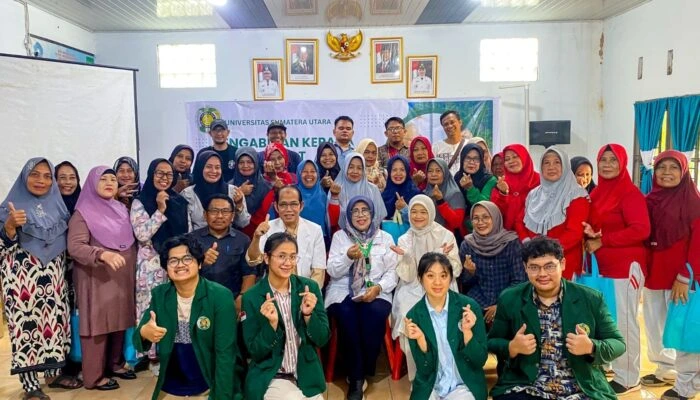
All lecturers and students posed for photos with the residents while chanting the slogan "Healthier, Happier."
https://www.waspada.id/pendidikan/dosen-usu-dorong-deteksi-dini-penyakit-diabetes-lewat-pemeriksaan-antropometri/