


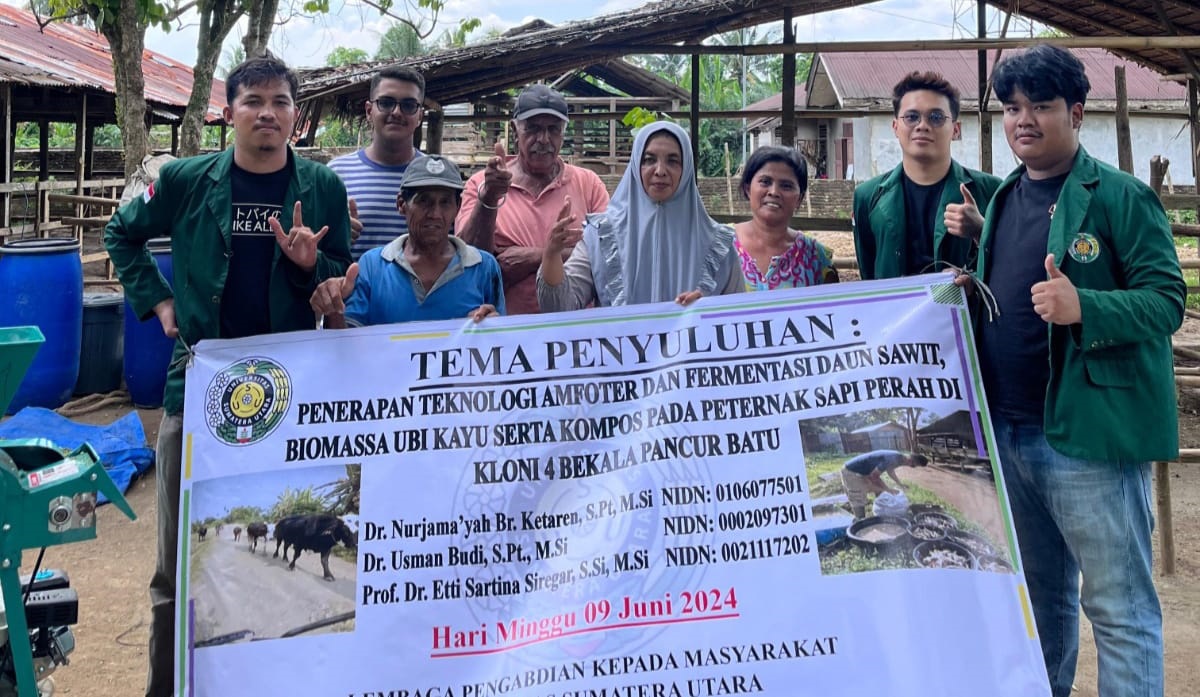
MEDAN. USU lecturers recently carried out Community Service in Kloni 4 Bekala Pancur Batu. The Community Service implementation team provided counseling on the use of oil palm leaves and cassava biomass waste consisting of cassava leaves, stems and skins as animal feed.
Oil palm leaf waste and cassava biomass still contain nutrients that can be used as animal feed but also have weaknesses due to the high crude fiber content, protein and low palatability levels as well as cyanide acid compounds (HCN) in cassava biomass. Utilization of this waste requires the application of fermentation technology by making amphoteric and silage. This processing will eliminate anti-nutrients, reduce crude fiber and increase palatability or livestock preferences.
This was conveyed by the USU community service team consisting of Dr. Nurjama'yah Br. Ketaren, S.Pt, M.Si, Dr. Usman Budi, S.Pt., M.Si and Prof. Dr. Etti Sartina Siregar, S.Si, M.Si after the Community Service on Sunday, June 9, 2024 as the implementation of the Regular Mono Year Partnership Program Service with the theme of economy and social was held by the USU Community Service Institute 2024. This activity involved students of the USU animal husbandry study program, namely M. Anshari Nasution, Brema Bastanta Sinukaban, Brema Sanja Edikel Tarigan and Fery Ardiansyah.
She said that the main problem for farmers is that they do not yet have knowledge about the importance of quality feed to increase livestock milk production. So far, they only know grass as the main feed for livestock. Farmers only graze their livestock around the oil palm plantations around USU Campus 2, Faculty of Forestry.
So that during the dry season, farmers have difficulty providing feed for their livestock. Farmers need to be given training on the utilization of plantation, agricultural and agro-industrial waste that can be used as animal feed for livestock productivity. So that it will increase income or the economy and welfare of farmers.
The community service team explained that providing quality feed and good livestock management are the keys to successful livestock farming. An intensive livestock maintenance system by simply keeping livestock in pens and then giving them feed with nutritional content according to livestock needs will produce optimal production.
The technology for making amphoteric feed (ammonia and fermentation) is an effort to increase the nutritional content of oil palm leaves because they have high crude fiber and low protein. Cassava biomass silage is the utilization of cassava waste with fermentation technology to improve the quality and shelf life of feed.
One of the solutions implemented by the team is to provide training in making fermented feed from oil palm leaf waste and cassava biomass. Livestock management greatly influences livestock production, especially milk. Intensive livestock management or keeping them in pens and providing quality feed and superior seeds greatly supports livestock productivity. Superior livestock seeds will produce optimal growth if supported by feed that has nutritional content according to livestock needs.
The location of the community service is close to the former oil palm plantation owned by PTPN 2 Kebun Bekala which has been donated to the University of North Sumatra. This location has become USU Campus 2 and the Faculty of Forestry has been established.
It is hoped that this community service activity can provide knowledge and skills to farmers about the types of plantation, agricultural and agro-industrial waste that can be used as animal feed using fermentation technology.
source: https://www.waspada.id/pendidikan/dosen-usu-latih-peternak-membuat-pakan-fermentasi-limbah-daun-sawit-dan-biomassa-tanaman-ubi-kayu/