


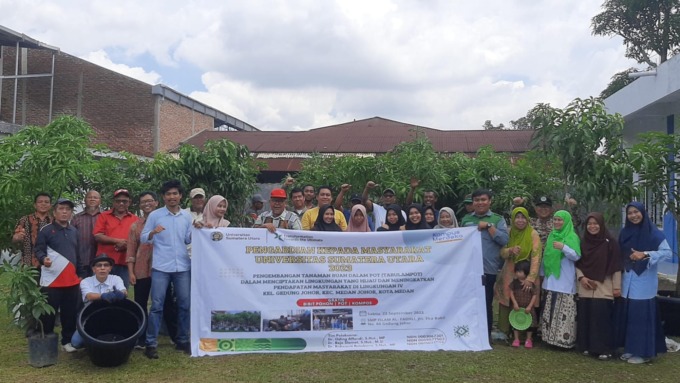
MEDAN, SUMUTPOS.CO – The Institute for Community Service (LPPM) of Universitas Sumatera Utara (USU) conducted a training on Developing Fruit Plants in Pots (Tabulampot) in Environment IV, Gedung Johor Subdistrict, Medan Johor District, Medan City. This activity, part of the regular mono-year community service program, was held at the Al-Fadhli Islamic Education Foundation, Jalan Eka Bakti No. 86, Saturday (September 23, 2023).
The community service activity was attended by Head of Environment IV, representatives from Gedung Johor Subdistrict, representatives from the North Sumatra Province Environmental and Forestry Service, community and religious leaders, the Karang Taruna management and members, as well as students from the Universitas Sumatera Utara’s Freedom to Learn Independent Campus (MBKM) program. The USU community service team included Dr. Oding Affandi as Chairperson, Dr. Bejo Slamet, and Dr. Ridwanti Batubara as members. The event also involved partners from the foundation and school management of the Al-Fadhli Islamic Education Foundation.
The series of activities began with socialization combined with practical tabulampot making and distributing trees, pots, and planting media to participants free of charge. In his remarks, the Committee Chair, Dr. Bejo Slamet, stated that this community service activity reflects academics' responsibility to support development and address problems within the community. The idea of this tabulampot-themed activity was inspired by global warming caused by climate change, which causes increased air temperatures.
“To reduce the negative impacts of climate change, we can plant trees. But since we live in urban areas with limited land availability, we plant trees in pots,” Bejo concluded.
Meanwhile, the Head of Gedung Johor Subdistrict, represented by Ade Sobirin, expressed the subdistrict’s strong support for the activity. “We appreciate and thank the USU community service team for organizing the Tabulampot activity. We hope this can be expanded to other communities in Gedung Johor to make our subdistrict a model Green Subdistrict,” Ade explained.
On another note, Head of Environment IV, represented by Akmal Nasution—who is also the Head of the Forest and Land Rehabilitation Division at the Environmental and Forestry Service—said the activity is very good and beneficial. “We hope the USU community service team continues to assist and educate recipients regarding seedling maintenance so that the planted trees can bear fruit and benefit both economically and environmentally,” Akmal added.
Furthermore, the Program Chairperson, Dr. Oding Affandi, explained that tabulampot is a cultivation technique of fruit plants in pots that can be done on limited land such as residential environments. According to him, the tabulampot development training is based on several factors: first, tree cutting due to residential or public infrastructure development such as roads; second, barren environments and increasing air temperature symptoms; third, lack of community skills to increase household income; and finally, the fading of social interaction among community members.
“Therefore, this tabulampot training is designed with the goals of creating a green and beautiful environment, increasing community income, and strengthening social bonds within the community,” Oding explained.
After the socialization session, participants immediately practiced making tabulampot under the guidance of a tree breeder from Madirsan Park, Joko Waluyo. “The key to tabulampot cultivation is choosing good quality seedlings, usually from cuttings or grafts. Maintenance, especially pruning and fertilizing, is also crucial. In certain conditions, to accelerate fruiting, we can give the plants a fruit booster,” Joko explained.
The practical session was met with enthusiasm from the community. Participants asked many questions and engaged in discussions, from the types of planting media used, fertilization frequency and fertilizer types, pest and disease control methods, to other plant maintenance processes to ensure the trees produce abundant fruit.
After the tabulampot practice, participants received a fruit tree, two sacks of compost, and a pot with a diameter of 60 cm. The trees distributed were mostly mango, longan, and avocado plants. Most of them were already flowering and beginning to bear fruit, which motivated participants in the program. (adz)