


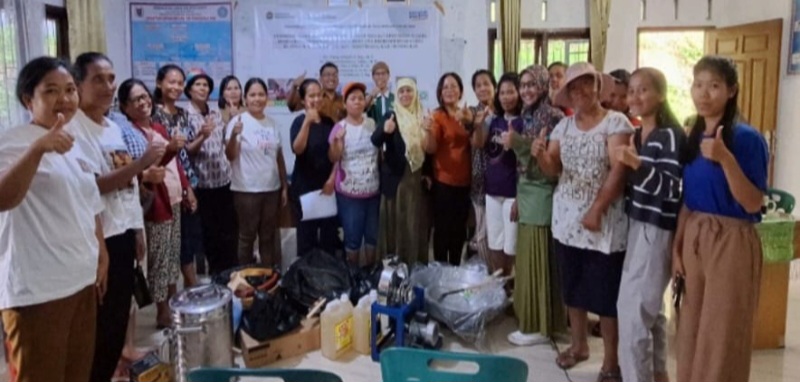
MEDAN. As a manifestation of the Tri Dharma of Higher Education (PT), the University of North Sumatra (USU) through the Community Service Institute (LPPM) has made Simangulampe Village a Foster Village in community service activities (PPM) in 2024.
One of the activities carried out is helping to resolve economic issues through the Mentoring activity for shallot-based businesses as a pioneering business based on local potential after the hydrometeorological disaster in Simangulampe Village.
This activity was carried out on August 19-20, 2024 at the Simangulampe Village Office, Baktiraja District, Humbahas Regency.
In addition to the mentoring activities, Productive Economic Tools (AEP) were also handed over in the form of fried onion processing facilities such as onion cutting machines, spinners, gas stoves, gas cylinders, frying pans, plastic packaging, sealers, and other tools to run a fried onion business.
This activity was carried out by the USU PPM Team, namely Dr. Oding Affandi (Head of PPM Fostered Village), Dr. Ridwanti Batubara (Coordinator of Economics), Astrid Fauzia, M.Sc, Dr. Rika Endah, and Mariah Ulfa, M.Sc. This activity was also attended by students participating in the independent learning campus independence (MBKM) USU.
Meanwhile, from the village, the Head of Simangulampe Village Lambok Simanullang, and the village government ranks were present.
There were also Community Leaders, and groups of housewives, and also the Sub-district Representative, Falber Simanullang, was present.
Oding Affandi in the activity said that, due to the disaster in Simangulampe, USU through LPPM made mitigation and adaptation efforts through Tri Dharma PT activities, especially PPM as a form of PT's concern as well as resolving problems arising from the impact of the disaster.
According to him, these mitigation and adaptation activities were carried out comprehensively covering various aspects, namely economic, social, and environmental aspects and involving parties, both government, private, community, and non-governmental organizations.
Meanwhile, disaster adaptation activities are the process of adjusting to a disaster or a form of adjustment used in responding to economic, social and environmental changes due to disasters. This adaptation activity is needed to increase awareness when living in disaster-prone areas that endanger life.
The Head of Simangulampe Village said that the village really welcomed this program and expressed his gratitude to the Implementation Team of the LPPM USU Fostered Village Program.
For the assistance of fried onion processing production equipment for residents.
"I hope that this activity will be followed as well as possible so that it becomes initial capital in developing household economics in the future," he said.
Given business tools
Ridwanti Batubara said that this mentoring activity includes education and providing information about shallots and the development of shallot-based businesses, providing business tools for developing shallot-based products, as well as training and direct practice in making shallot-based products, especially fried onions.
According to him, the selection of the fried onion business development was based on the results of the focus group discussion (FGD) activities with housewives that were carried out previously.
As is known, in Simangulampe Village there are natural resources that have long been developed by the community, namely shallot plants.
There are even local Lembah Bakara shallots that have the characteristics of plants that are more resistant to pests, the processed products are more fragrant and "crispy" and are used in traditional party needs by the community.
On the other hand, the selling price is also relatively higher when compared to Brebes onions which are generally developed by the community.
It was stated that based on the agreement with the mothers here, we will develop the Lembah Bakara Fried Onion business with various products such as pure fried onions, fried onions with anchovies, fried onions with flour, and fried onion oil.
"Hopefully with this activity, the efforts of the mothers, especially the Ceria Simangulampe Housewives (CES) in terms of developing onion-based products in the future can run and develop so as to increase household income, especially after the disaster some time ago," said Ridwanti.
Assistance in developing onion businesses as well as assistance in making legalities, namely group notary deeds, opening group savings accounts, making NPWP, brand permit numbers, managing Business Identification Numbers (NIB), and several distribution permits for processed food products
Source: https://www.waspada.id/medan/lppm-usu-lakukan-pendampingan-usaha-bawang-goreng-di-desa-simangulampe/