


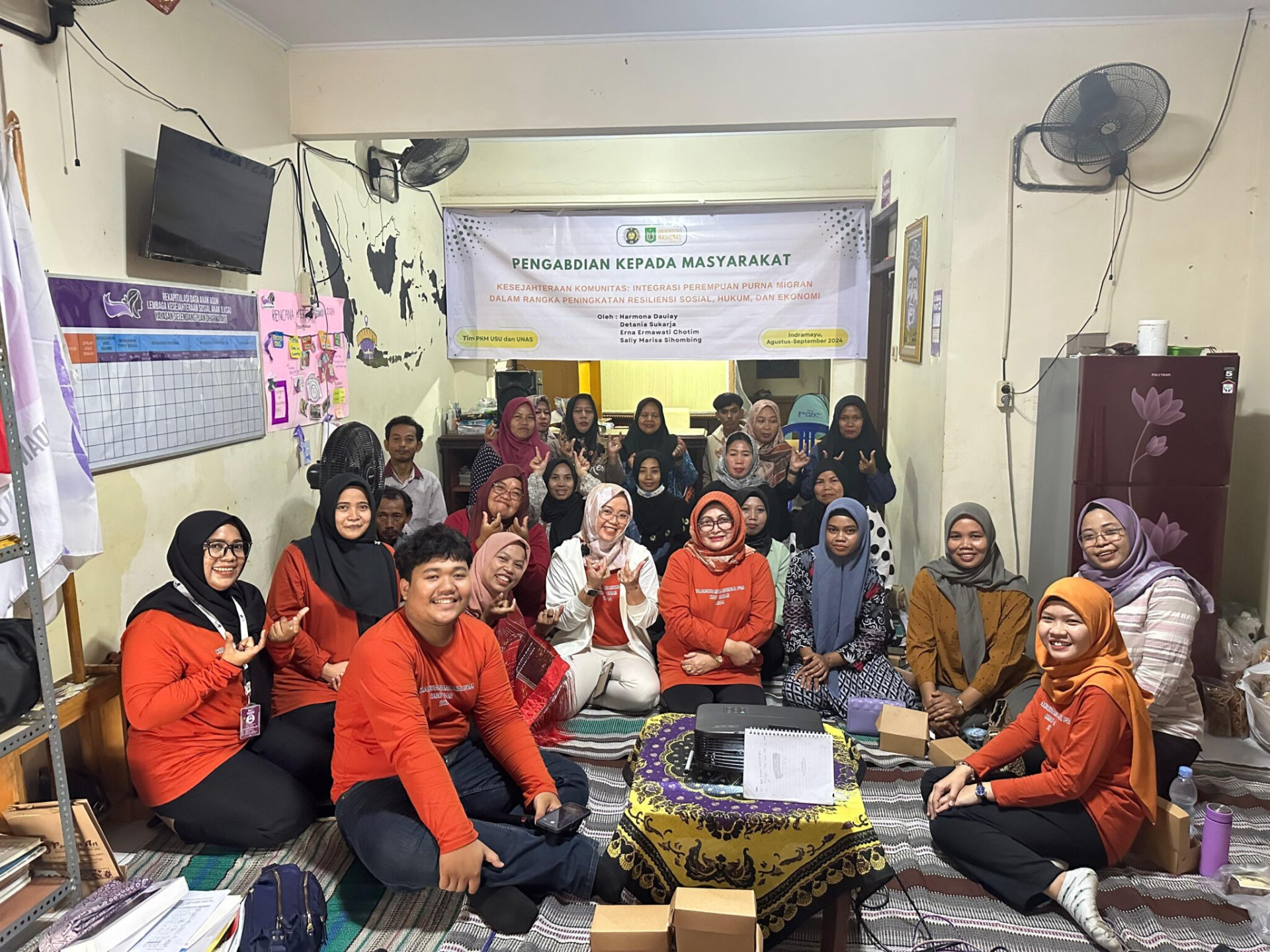
MEDAN, In an effort to strengthen the social, legal, and economic resilience of Indonesian Returning Migrants (PMI), the Community Service Team (PKM) of the University of North Sumatra (USU) and the National University (UNAS) held a series of socialization activities, in collaboration with the Selendang Puan Dharma Ayu Foundation in Indramayu.
This activity was chaired by Dr. Harmona Daulay, M.Sc. (Deputy Dean III of the USU FISIP) along with three other team members, namely Dr. Detania Sukarja, SH, LLM. (Lecturer at the USU FH), Dr. Erna Ermawati Chotim, M.Sc. (Dean of the UNAS FISIP), and Dr. R. Sally Marisa Sihombing, S.I.P., M.Sc. (Lecturer in Public Administration at the USU FISIP).
Dr. Harmona Daulay, M.Sc. said, the community service program that runs from August to September 2024 aims to empower women who are former migrants who are members of the Selendang Puan Dharma Ayu Foundation, with a special focus on issues of gender equality and economic resilience. On August 8, 2024, the first socialization activity was held at the Selendang Puan Dharma Ayu Foundation, attended by 20 participants, consisting of 15 women and 5 men who are former migrants.
He said, this activity began with a socialization session on gender issues delivered by Dr. Harmona Daulay, M.Sc., a lecturer from the USU FISIP. In this session, various issues related to gender injustice and gender-based violence that are often experienced by women who are former migrants became the focus of discussion. The material was delivered with an interesting visual approach, supported by videos that illustrated these issues.
Furthermore, he said, this discussion aims to increase participants' awareness of the importance of gender equality and the need for a proactive attitude in preventing gender violence in their environment. Gender issues are particularly relevant in the context of post-migration, given that many migrant women often experience discrimination and violence, both in the countries where they work and after returning home.
A deep understanding of gender equality can be key to changing society's perceptions and behaviors towards women, especially those who have worked abroad.
This awareness will not only impact the personal lives of post-migrants, but will also strengthen the community as a whole through more equitable and inclusive practices. After the session on gender issues, the activity continued with a socialization on economic resilience delivered by Dr. Erna Ermawati Chotim, M.Sc., from UNAS.
The material presented included the basic principles of financial planning for post-migrants, with an emphasis on the importance of financial preparation for facing retirement.
This session was not only theoretical, but also involved direct practice in making financial plans by the participants, which is expected to help them manage their income more effectively and sustainably.
Furthermore, effective remittance management is an important focus in improving the welfare of post-migrant communities. Well-managed remittances will not only create social resistance to poverty and inequality, but also become a source of financing and support for the local economy. Strong management can increase employment and encourage sustainable development.
Therefore, it is very strategic if the government and related institutions can provide a special policy umbrella for remittance management, including clear regulations, incentives for productive use of remittances, and training in financial management.
With this approach, remittances can be an effective tool to strengthen social and economic resistance for former migrants and the community.
During the activity, the atmosphere was warm and full of enthusiasm. The participants were actively involved in the discussions and practices provided, showing their high interest and desire to learn and apply new knowledge.
In the testimonial session, the participants expressed their satisfaction and gratitude for the insights they had gained, which not only increased their knowledge but also motivated them to further fight for gender equality and prepare for a better economic future.
This activity ended with the signing of a cooperation agreement between the service team and the Selendang Puan Dharma Ayu Foundation, as well as the giving of souvenirs as a symbol of appreciation for the foundation's support and participation. This signing marks a joint commitment to continue supporting the welfare and empowerment of former migrants in Indramayu.
This service activity does not stop here. The implementing team plans to hold further socialization that focuses on legal aspects, as well as monitoring and evaluating ongoing activities. The results of this evaluation will be used to improve the quality of the program in the future, ensuring that the positive impacts that have been achieved can be sustained and developed into larger initiatives.
Continuous cooperation and support from various parties, including the government and non-governmental organizations, are needed to consolidate the results of this service.
Thus, it is hoped that the Selendang Puan Dharma Ayu Foundation and the PMI members in it can continue to develop themselves and contribute significantly to the welfare of the community and the surrounding environment.
source: https://www.waspada.id/medan/tim-pkm-usu-unas-edukasi-pmi-di-indramayu-tentang-gender-dan-resiliensi-ekonomi/