


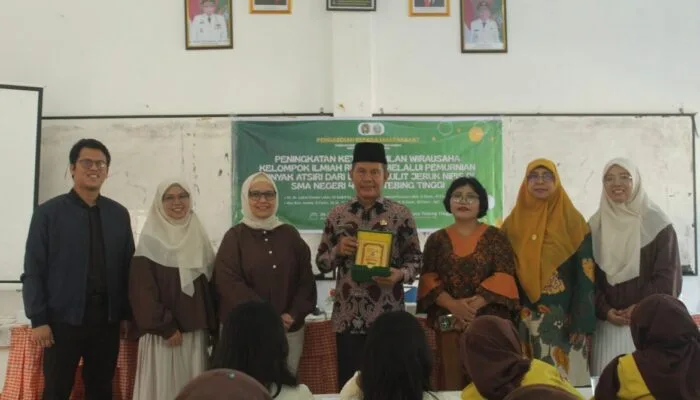
This program, part of the University of North Sumatra (USU) Community Service program, aims to improve students' entrepreneurial skills while providing solutions for utilizing organic waste to make it more useful.
The program, held in collaboration with a team of lecturers from the Faculty of Medicine, Dr. dr. Lokot Donna Lubis, M.Ked(PA)., Sp.PA, and the USU Faculty of Pharmacy, including apt. Muhammad Fauzan Lubis, S.Farm, M.Farm; apt. Ade Sri Rohani, S.Farm, M.Farm; and apt. Nur Aira Juwita, S.Farm, M.Si., began with a sex education session to provide a comprehensive understanding of adolescent health, followed by a paper soap-making workshop. The Community-Based Interactive Approach (CBIA) method used consisted of three stages: preparation, implementation, and monitoring and evaluation.
In the initial stage, KIR students received education on the potential of lime peel waste, which is rich in essential oils with natural antibacterial properties and a fresh, citrus aroma. This fostered environmental awareness and sparked creativity in waste management.
Next, the students practiced the essential oil purification process in the school laboratory and formulated it into paper soap, a modern, practical, portable, and hygienic product rarely found among students.
This process demonstrated that science can be combined with entrepreneurial skills to create innovative products that benefit the community.
The students' paper soaps were then evaluated through various scientific tests. Organoleptic tests revealed the soap to have a soluble texture, measure 2.5 x 2.5 cm, be white/ivory, and have a lime aroma. The pH value was within the safe range for skin (5.5-6.5).
The hedonic test showed very good acceptance, with 10 respondents expressing liking to strongly liking the texture and aroma. The irritation test also confirmed the soap's safety, as it did not cause redness or itching.
Equally important, antibacterial testing using the disc diffusion method demonstrated a 6.88 mm inhibition zone for Escherichia coli and 9.75 mm for Staphylococcus aureus, indicating that this paper soap not only functions as a cosmetic product but also has functional benefits as a natural antibacterial agent.
In addition to producing a quality product, this activity also significantly improved students' skills. Based on the learning evaluation results, there was an increase in average understanding from pre-test to post-test scores.
This demonstrates that students not only understand the theory but also master the practical application of utilizing natural materials to create economically valuable products.
This improvement is an indicator of the activity's success in equipping students with science-based entrepreneurial skills. This community service activity demonstrated that utilizing simple waste such as lime peels can produce innovative, useful products.
For the students, this experience was not only about making paper soap, but also a valuable lesson in the importance of innovation, environmental awareness, and entrepreneurial skills as preparation for the future.