


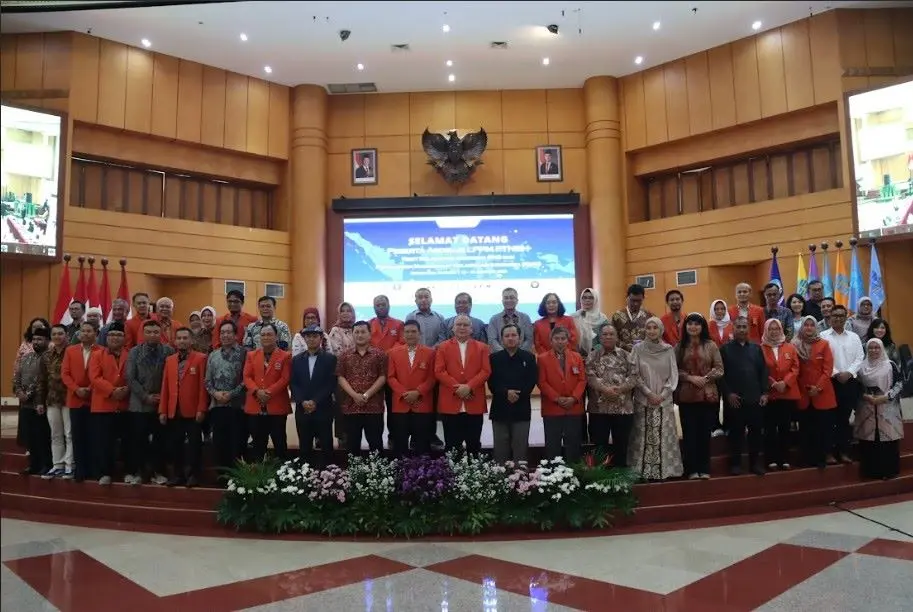
The Community Service Institute of the University of North Sumatra attended the meeting of the Association of Research and Community Service Institutes (LPPM) from 24 Legal Entity Universities (PTNBH) held at the Open University Headquarters in Pondok Cabe, Pamulang, South Tangerang. This activity was attended by the Head of LPPM USU Prof. Dr. Tulus Vor.Dipl.Math., M.Si., Ph.D.
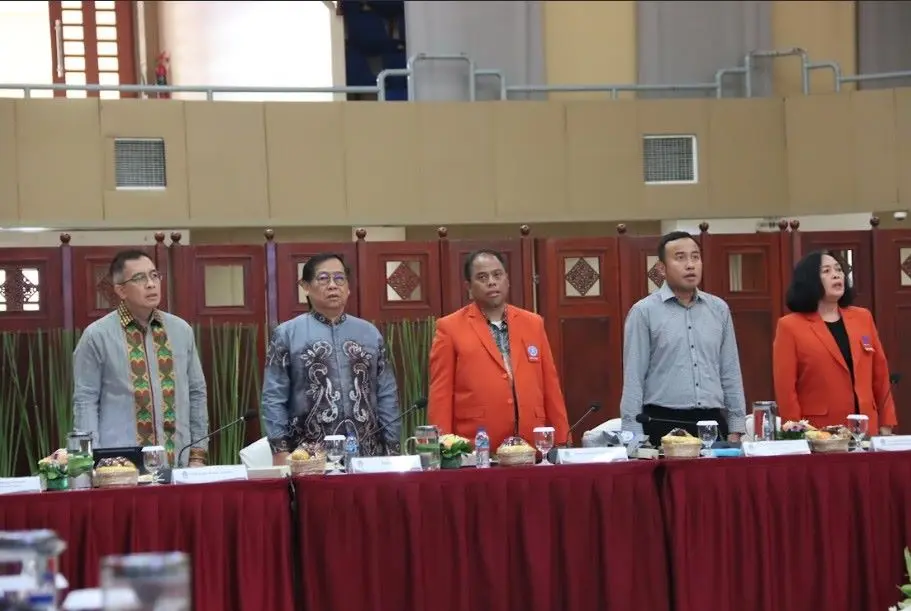
This event took place at the Universitas Terbuka Convention Center (UTCC), UT Center, South Tangerang. This event was attended by the Director General of Research and Development of the Indonesian Ministry of Education and Technology, Dr. Fauzan Adziman, S.T., M.Eng., Chairman of the LPPM PTNBH Association Dr. Yuli Setyo Indartono, S.T., M.T., Deputy Chairman of the LPPM PTNBH Association, Prof. Dr. R Benny Riyanti, S.H., M.Hum., CN., Leaders of Institutions/Directors of Research and Community Service of PTNBH, Coordinator of Research and Development of Science and Technology of BAPPENAS, Ade Faisal, S.T., M.Sc., UT Chancellor Dr. Mohamad Yunus, S.S., M.A., UT Vice Chancellors, Deans and Directors of UT Postgraduate Schools, the management of the LPPM PTNBH Association, and representatives from various PTNBH throughout Indonesia.
Head of LPPM UT, Prof. Dra. Dewi Artati Padmo Putri, M.A., Ph.D expressed her pride that this is a valuable momentum, because UT as a relatively new PTNBH has the opportunity to host this prestigious event. Prof. Dewi also said that the launch of the Indonesian Collaborative Research Program and Indonesian Community Service in 2025 will further strengthen the synergy and positivity between universities so that it will bring more benefits and empowerment to the community. "Hopefully the two programs initiated by the LPPM PTNBH Association can encourage researchers/lecturers to always produce rich innovations through research collaboration with other researchers in the country and produce outputs that can be published through reputable journals," said Prof. Dewi.
UT Chancellor, Dr. Mohamad Yunus, S.S., M.A. in his speech emphasized the importance of synergy and collaboration in research and community service. "Of course, this forum not only strengthens research collaboration and community service but also strengthens scientific insight between researchers, increases the number of international journal publications, and improves the ranking of universities and also research collaboration on a national and even global scale. We believe that collaborative research and community service activities in 24 PTNBH will take place continuously," he said.
Mohamad Yunus also emphasized that to support Indonesia Emas 2045, the academic community in Indonesia, especially in universities that are members of PTNBH, carries out the mandate and key roles, both in the social, economic and innovation fields, law enforcement, and ecology. "Achieving Indonesia Emas requires support from all academic communities in mastering knowledge and competence with character. This is our common hope," said Mohamad Yunus.
The RKI and PMKI programs themselves are flagship programs of the LPPM PTNBH Association which aim to improve Indonesia's academic competitiveness both at the national and global levels. The results of this activity formulate the agenda, plan, and implementation of the Indonesian collaborative research and PkM program which then produces novelty from scientific and technological innovations in various fields of life. Through this activity, universities can build and expand research and PkM collaboration networks with leading universities in Indonesia, strengthen scientific insights that are multi, inter, or cross-disciplinary, and increase the number of international journal publications indexed by at least Scopus which can later improve the university's ranking in QS/THE.
By holding this meeting, UT not only strengthens its position as a center for distance learning, but also as an institution that actively encourages the transformation of research and innovation that is more inclusive and has a broad impact on society.
Source: https://www.ut.ac.id/berita/2025/02/ut-pimpin-kolaborasi-dahsyat-24-ptnbh-bersatu-untuk-riset-dan-inovasi-pkm-2025/