


The SDGs represent a global agreement on a global action plan to end poverty, reduce inequality, and protect the environment. These goals consist of 17 objectives and 169 targets that are expected to be achieved by 2030.
Through their Tri Dharma (three pillars)—education, research, and community service—universities play a key role in supporting the integration of teaching and research values to provide practical benefits to society. These activities can have a structured and sustainable direction by aligning community service with the SDGs.
Out of the 17 SDGs, LPPM-USU prioritizes eight goals as the foundation for community service activities:
- Good Health and Well-being (Ensure healthy lives and promote well-being for all ages).
- Quality Education (Ensure inclusive and equitable education and promote lifelong learning opportunities for all).
- Gender Equality (Achieve gender equality and empower all women and girls).
- Decent Work and Economic Growth (Promote sustained, inclusive, and sustainable economic growth, full and productive employment, and decent work for all).
- Industry, Innovation, and Infrastructure (Build resilient infrastructure, promote inclusive and sustainable industrialization, and foster innovation).
- Reduced Inequalities (Reduce inequality within and among countries).
- Climate Action (Take urgent action to combat climate change and its impacts).
- Peace, Justice, and Strong Institutions (Promote peaceful and inclusive societies, provide access to justice for all, and build effective, accountable institutions).
This global policy is a foundation for USU’s academic community in drafting community service proposals. Its realization is expected to significantly impact SDG achievement in Indonesia through USU.
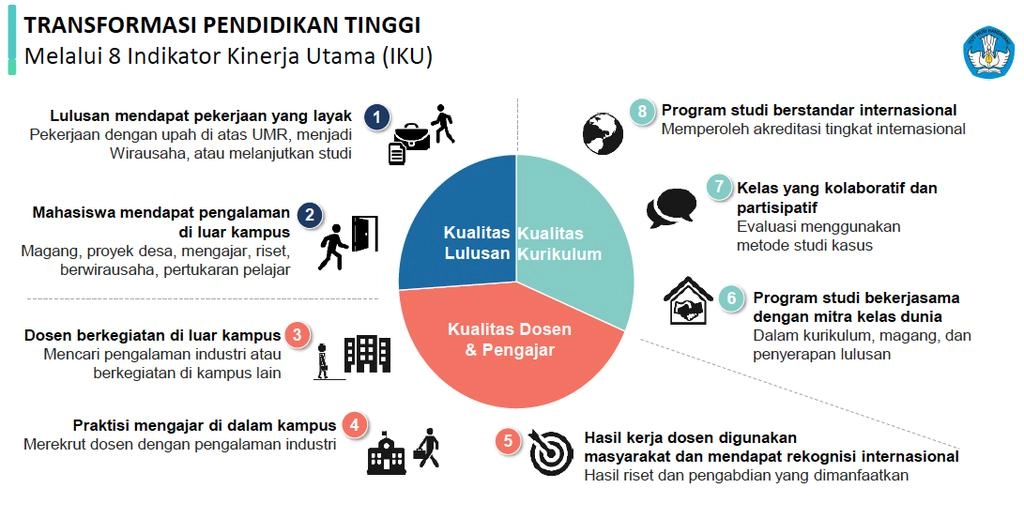
Another policy guiding community service activities is the Key Performance Indicators (IKU) for higher education institutions, which include eight key indicators:
- IKU 1 : Graduates Securing Decent Jobs – Ensuring graduates are employed, self-employed, or pursuing further studies.
- IKU 2 : Students Gaining Off-Campus Experience – Encouraging internships, research, community projects, entrepreneurship, or teaching activities.
- IKU 3 : Lecturers Engaging in Off-Campus Activities – Promoting lecturers’ participation in industry practices or teaching at other institutions.
- IKU 4 : Practitioners Teaching On-Campus – Involving experienced professionals to provide practical knowledge.
- IKU 5 : Lecturers’ Work Benefiting Society – Ensuring research outputs address societal needs.
- IKU 6 : Study Programs Collaborating with World-Class Partners – Establishing partnerships for internships, graduate absorption, and curriculum improvement.
- IKU 7 : Collaborative and Participatory Classes – Creating dynamic learning environments with active student engagement.
- IKU 8 : Internationally Accredited Study Programs – Aiming for global recognition of study programs.
This policy is a fundamental framework for USU’s academic community when developing community service proposals. Including at least one IKU in each 2022 proposal will enhance USU’s performance and contribute to its institutional achievements.