


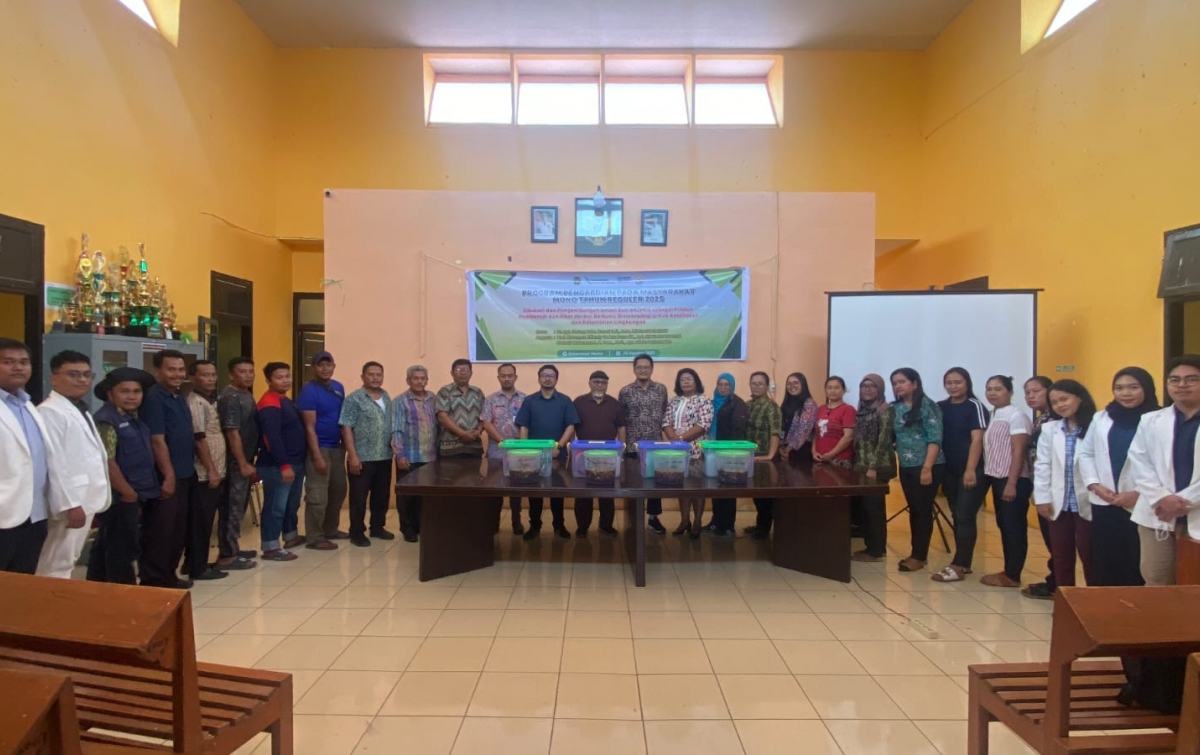
Residents of Munthe District, Karo Regency, enthusiastically participated in a community service activity titled "Education and Development of Smart Eco-Enzymes as Biotechnology-Based Cleaning Products and Herbal Medicines for Health and Environmental Sustainability," held in the district hall. The goal of the service was simple yet impactful: teaching the community how to process household organic waste into an environmentally friendly multipurpose liquid.
When opening the activity, the Secretary of the Munthe District Head expressed his appreciation for the service. He emphasized the importance of collaborative efforts in managing organic waste, which often poses a problem in the surrounding environment. "We welcome this initiative. We hope that residents can practice it directly at home and make it a beneficial new habit," he said.
The community service team from the University of North Sumatra, consisting of Dr. apt. Dadang Irfan Husori, S.Si., M.Sc., Prof. Dr. rer.nat. Effendy De Lux Putra, SU., Apt., and Mahatir Muhamad, S.Farm., M.Si., Apt., then delivered the material in a communicative and easy-to-understand manner.
The material included examples of eco-enzymes' use in everyday life, from floor cleaners and organic fertilizers to pest repellent solutions.
In his explanation, Dr. apt. Dadang Irfan Husori, S.Si., M.Sc. emphasized the importance of changing people's mindsets about kitchen waste.
"Fruit peels and vegetable scraps, previously considered waste, can actually be processed into useful products, even those with economic value," he said.
The activity continued with hands-on practice, divided into four groups of five. With enthusiasm, they prepared ingredients such as fruit scraps, brown sugar, and clean water for fermentation in plastic containers.
The resulting mixture was labeled and allowed to ferment for three months. This simple process apparently made residents even more enthusiastic about trying it at home. One housewife even admitted that she had just learned that kitchen waste could be processed into a multipurpose liquid.
During the discussion session, Prof. Dr. rer.nat. Effendy De Lux Putra, SU., Apt. added that eco-enzymes are not only useful for households. However, it can also help maintain environmental cleanliness.
"If people are willing to make it consistently, this can be a solution for organic waste management at the family level. We're not only reducing waste, but also producing something useful," he explained.
Meanwhile, Mahatir Muhamad, S.Farm., M.Si., Apt. encouraged the community to see the economic potential of eco-enzymes. He said that this product has begun to attract market attention due to the growing trend of environmentally friendly lifestyles.
"If residents can process it in groups, the results can be packaged and sold. So, it's not just for personal use, but also a new source of income," he said.
Through this activity, the people of Munthe District not only gained new knowledge but also gained practical experience that can be immediately applied.
Furthermore, the spirit of togetherness fostered during the training demonstrated that waste management can be a gateway to creating a cleaner environment and a promising business opportunity.