


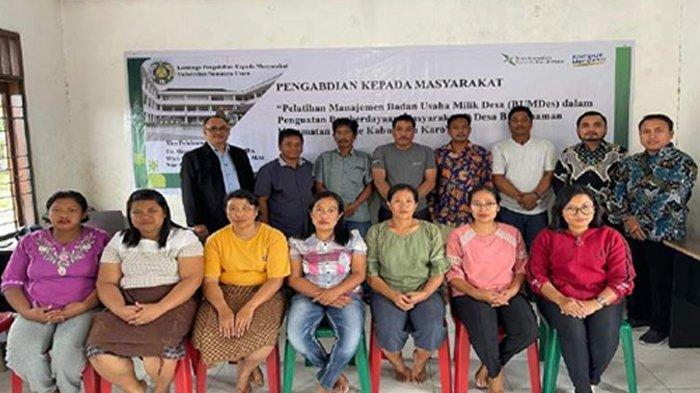
KARO – Public Administration lecturers from Universitas Sumatera Utara, Dr. Simson Ginting, S.Sos., M.PA, Wiro Oktavius Ginting, S.Sos., M.Si., and Nur Afifah, S.AP., M.PA., conducted a Community Service activity under the Regular Mono Scheme with the theme “BUMDes Management Training to Strengthen Community Empowerment” in Buluhnaman Village, Munte District, Karo Regency, on Friday (01/09/2023).
Based on the situation analysis by the PKM team, the common problem faced by Buluhnaman Village’s BUMDes is the weak institutional strengthening of BUMDes as a crucial component for its success. Given this, there is a need to conduct training and mentoring by formulating strategies in terms of service, organizational aspects, and resource management.
This effort aims to encourage BUMDes to increase productivity and consequently improve community welfare. The lack of or inadequate planning for BUMDes programs and activities is caused by limited knowledge among the management and actors about good and ideal BUMDes governance. This tends to result in stagnation of BUMDes. Additionally, low literacy in information technology to support administrative and marketing governance makes BUMDes in Buluhnaman Village less than optimal.
“Villages in Karo Regency have the potential to develop village enterprises through Village-Owned Enterprises (BUMDes), tailored to the needs and potentials of each village. To optimize this potential, the USU PKM Team is here to conduct training on governance and management for the Village Head, Village Consultative Body (BPD), village officials, BUMDes management, and representatives of the Buluhnaman Village community,” said Dr. Simson Ginting, S.Sos., M.PA, as the head of the PKM team.
“Buluhnaman holds great potential ranging from tourism to MSMEs that can be optimized by BUMDes. This training aims to ensure that BUMDes in Buluhnaman Village has good governance and management and is responsive in identifying the village’s potential. Besides providing governance and management training, we also offer mentoring and consultation through a coaching clinic so that the benefits of the training can be sustainable,” added the PKM Chair, who is also currently serving as the Deputy Head of MKWK and General Affairs at UPT. PP LIDA USU.

The delivery of the material presentation was followed by a Focus Group Discussion (FGD) held by the PKM Team together with local government officials and community representatives at the Buluhnaman Village Office Hall. Wiro Oktavius Ginting, S.Sos., M.Si., stated that one form of USU’s dedication to the community is the Science and Technology program for villages, aimed at realizing the university’s active role in supporting village community development.
This community service is crucial because many village potentials remain underutilized due to a lack of alignment between research outcomes and community aspirations. The young lecturer, who previously served as an Expert Staff for the North Sumatra Provincial Government, shared his experience on strategies for developing village resource potentials and emphasized the importance of BUMDes in supporting the achievement of the village’s Sustainable Development Goals (SDGs), with BUMDes acting as the frontline driver for economic growth in the village.
Dr. Simson Ginting, S.Sos., M.PA., the first speaker of the event, explained that the training focused on the business units owned by BUMDes. During the training, participants were provided with guidance on selecting appropriate BUMDes business units that align with the potentials available in Buluhnaman Village. Choosing the right business units is critical and should be based on the village’s unique potentials. For example, a waste management business unit could be managed by BUMDes, which would not only generate profit but also provide broader community benefits.
“Buluhnaman Village actually has many other business units that can be developed and utilized by BUMDes, such as the development of soda ponds similar to those found in North Tapanuli and Venezuela—a country located at the northern tip of South America—rafting rivers, caves, and the village’s rice field hills. The orientation of village development through the utilization of Village Fund programs managed via BUMDes is expected to maximize local potential. Mapping village potentials to be targeted as development programs and economic opportunities can be employed to empower the village community through innovation and creativity,” said Dr. Simson Ginting, S.Sos., M.PA.
In the following session, Wiro Oktavius Ginting, S.Sos., M.Si., equipped participants with material on governance and business management, focusing on how to enhance the capacity of BUMDes managers and officials. This was followed by discussions on financial management, including how BUMDes officials can prepare financial reports, bookkeeping, and other managerial financial tasks. As a follow-up to the training, coaching clinics were provided, which can be accessed at any time by BUMDes actors in Buluhnaman Village.

“We hope that this village’s BUMDes can become more independent, that its operations run smoothly, and that it can generate profits effectively,” said Wiro Oktavius Ginting, S.Sos., M.Si., concluding his presentation. “BUMDes here can serve as a pioneer in developing creative economic ventures and village tourism. Therefore, revitalization is needed in terms of institutional structure, licensing, and active community participation so that BUMDes can inclusively develop the village and the local economy.”
According to Nur Afifah, S.AP., M.PA., who spoke via phone, collaboration and involvement with higher education institutions produce knowledge, learning, dissemination, and benefits. Villages and universities mutually support each other. Universities provide knowledge, innovation, and solutions to village development problems, acting together as agents of sustainable development at the village level by demonstrating academic concepts and designs.
“BUMDes should not simply imitate others; it must utilize the potentials and meet the needs of its own village. Secondly, avoid wasteful spending—BUMDes must use its funds effectively and efficiently. Thirdly, be consistent in running BUMDes operations and follow the BUMDes Articles of Association and Bylaws (AD-ART),” Nur Afifah advised.
The Village Secretary, Head of the Village Consultative Body (BPD), BUMDes Management, and Community Representatives expressed their gratitude and appreciation that Buluhnaman Village received attention from the USU PKM Team aimed at strengthening community empowerment through BUMDes Governance and Management training. “We are very grateful and thankful for the productive discussions that took place. We will conduct socialization for drafting Village Regulations as legal support for BUMDes’ existence, map the village’s potentials—many of which are tourism attractions that can be further developed for greater benefit—expand business units, and carry out accurate data collection to accommodate community aspirations,” they said.
This article was originally published on Tribun-Medan.com under the title: "Optimalkan BUMDes, Tim PkM USU Gelar Pelatihan Tata Kelola dan Manajemen Pemberdayaan Masyarakat," available at https://medan.tribunnews.com/2023/09/04/optimalkan-bumdes-tim-pkm-usu-gelar-pelatihan-tata-kelola-dan-manajemen-pemberdayaan-masyarakat.