


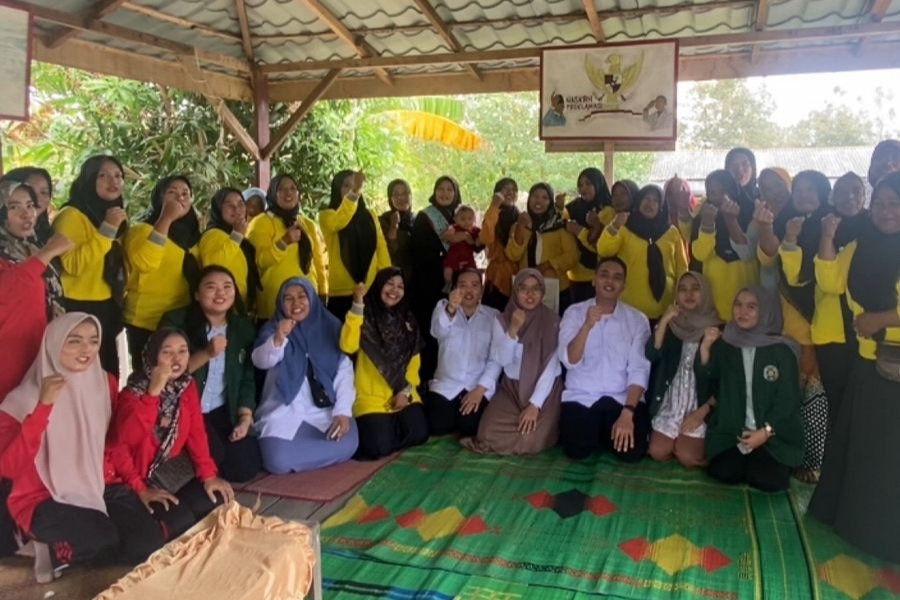
SERGAI - USU academics from the Undergraduate Nursing Study Program provided assistance in making anti-bacterial plaster made from sea pandan fruit (Pandanus Tectorius) to posyandu cadres and KSU member communities in Sei Nagalawan Village, Perbaungan District, Serdang Bedagai Regency (Sergai), Saturday (01 /06/2024).
Head of the Community Assistance Team for the Undergraduate Nursing Study Program, USU, Bina Melvia Girsang, Saturday (22/06/2024), said that community assistance activities are an effort to increase the value of the potential benefits of natural resources in Nagalawan Village, especially in the use of sea pandan fruit. .
He said that the sea pandan plant had not been utilized optimally by the people of Nagalawan Village, even though many of them grew wild. The fruit is deliberately left to fall and rot after it is ripe. Most local people even think that the presence of sea pandan plants actually disturbs the beauty and scenery of beach tourism.
"In fact, several studies have proven that sea pandan fruit can be processed into antibacterial plaster," he said, accompanied by four members of the Community Assistance Team, namely Lisda Rismayani Nasution, Kristiawan Hadinata Ginting, and Eqlima Elfira, as well as three Bachelor of Nursing students, USU, namely Novri Rahmadhani Nasution (211101005), Sonia Rospita Hia (211101006), and Della Amelia Nasution (211101007).
According to Bina, sea pandan is a type of plant from the genus Pandanus or pandan-pandanan, which is mostly distributed in tropical areas, both on beaches and rivers, but is not found on the American continent. This plant has many benefits for society, because it is often used as raw material for making sewing mats, woven mats and serving hoods.
The sea pandan itself is a tree or shrub that grows upright, between 5 and 15 meters high, with branching, sometimes thorny stems, with non-widening supporting roots. The leaves are large, between 5 and 6 meters long, between 7 and 10 centimeters wide, the tip of the leaf is sharp triangular, the edge of the leaf and the lower spine of the leaf are spiny, the texture of the leaf is waxy, and the color is light green and dark green. Male and female flowers are found on different plants. Meanwhile, the fruit of the sea pandan plant is terminal or lateral, solitary or in the form of large grains or panicles. (Ramandey, et al: 2021).
According to him, the use of sea pandan plant extract in the form of simplicia as a medicine to help heal topical wounds is still considered impractical. So it is necessary to find a relatively appropriate formula so that this material can be used more effectively and efficiently.
"On that basis, we experimented with processing sea pandan fruit into wound plasters. Of course this is one solution in using the jnj plant, because it contains antiseptic or antibacterial properties, as well as the natural ability to cover acute wounds or abrasions," explained Bina.
By assisting his party in making antibacterial plaster, he hopes that this effort can increase the beneficial value of sea pandan plants and increase the skills of the people of Nagalawan Village in processing the potential natural resources that exist in their area.
"So, the main aim of this activity is to provide education and understanding to the people of Nagalawan Village about the benefits of sea pandan fruit and how to process it properly so that it can be used to help with the treatment process," said Bina.
Source: https://sumutnews.sigapnews.co.id/lingkungan/sn-71507/akademisi-usu-dampingi-pembuatan-plester-anti-bakteri-dari-buah-pandan-laut